What does bouillabaisse mean?
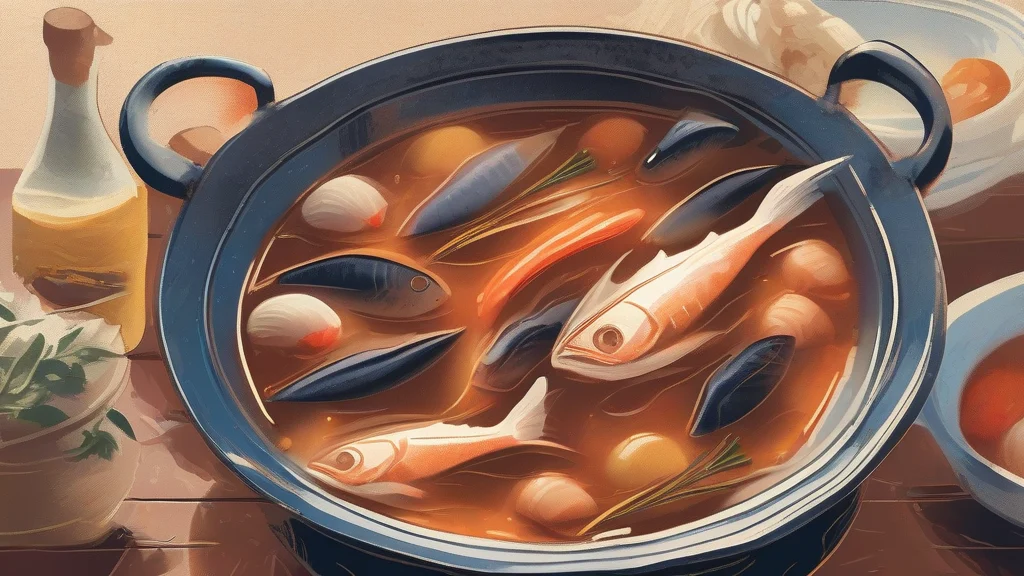
Bouillabaisse is a celebrated fish stew that originated among fishermen in Marseille, in the Provence region of southern France. Traditionally, it combines several varieties of rockfish and shellfish poached in a rich broth flavoured with olive oil, garlic, tomatoes, fennel, orange peel, and saffron, and it is classically presented in two stages: the aromatic broth is served first over croutons spread with rouille, a garlicky red-pepper mayonnaise, followed by the fish itself. The name derives from the Provençal phrase meaning roughly 'to boil and simmer', reflecting its method of preparation. In English usage, bouillabaisse is a noun referring both to the specific Provençal dish and, more loosely, to any similar seafood stew prepared in that style. The word evokes Mediterranean sunshine, maritime tradition, and rustic yet sophisticated French cooking, making it a favourite on upscale menus and in food writing.
nounA traditional Provençal fish stew originating in Marseille, made with several kinds of fish and shellfish, simmered with olive oil, garlic, tomatoes, saffron, and herbs, and typically served with rouille sauce and crusty bread.
- A Provençal fish stew from Marseille made with mixed fish and shellfish in a saffron-and-olive-oil broth, traditionally served with rouille and bread.
"The restaurant's Friday special is a fragrant bouillabaisse brimming with saffron-scented broth and fresh Mediterranean seafood."
"On the harbour front in Marseille, we ordered a classic bouillabaisse served in two courses — first the saffron broth with croutons spread with rouille, then the whole poached fish."
"Her cookbook devotes a chapter to French classics, but it's the bouillabaisse that guests request again and again."
Rarely used; bouillabaisse normally functions as a mass noun, though the plural appears occasionally when referring to multiple servings or regional varieties.
"The festival featured bouillabaisses from a dozen different coastal towns."
In Marseille, authentic bouillabaisse is so fiercely protected that its recipe is governed by an official charter — and it's traditionally served in two courses: the broth first, the fish after.
Reviewed by Deb Chak, Editor. AI-assisted content curated by RJS Tech Solutions LLP.
Etymology of bouillabaisse
Bouillabaisse entered English in the early nineteenth century from French, ultimately deriving from the Provençal 'bolhabaissa', a compound of two verbs describing the cooking process: 'bolhir' (to boil) and 'abaissar' (to reduce, lower, or simmer). The first element shares a root with English 'boil', while the second traces back through Vulgar Latin to the same base underlying words like 'abase' and 'base', reflecting the idea of lowering the heat. The word thus encodes the dish's essential technique — boiling the broth briskly before letting it simmer gently.
How bouillabaisse is actually used
The word carries a distinctly culinary and somewhat refined connotation; it is almost always used literally about the dish rather than figuratively. Because it denotes a specific regional specialty, writers often capitalize on its association with Marseille and Provençal cuisine. In English it functions as a mass noun, so phrases like 'a bouillabaisse' are less common than 'a bowl of bouillabaisse' or 'some bouillabaisse'.
Easily confused with bouillabaisse
Bisque is a smooth, creamy soup usually thickened with rice and made from shellfish such as lobster, whereas bouillabaisse is a brothy Provençal stew of mixed fish served with rouille.