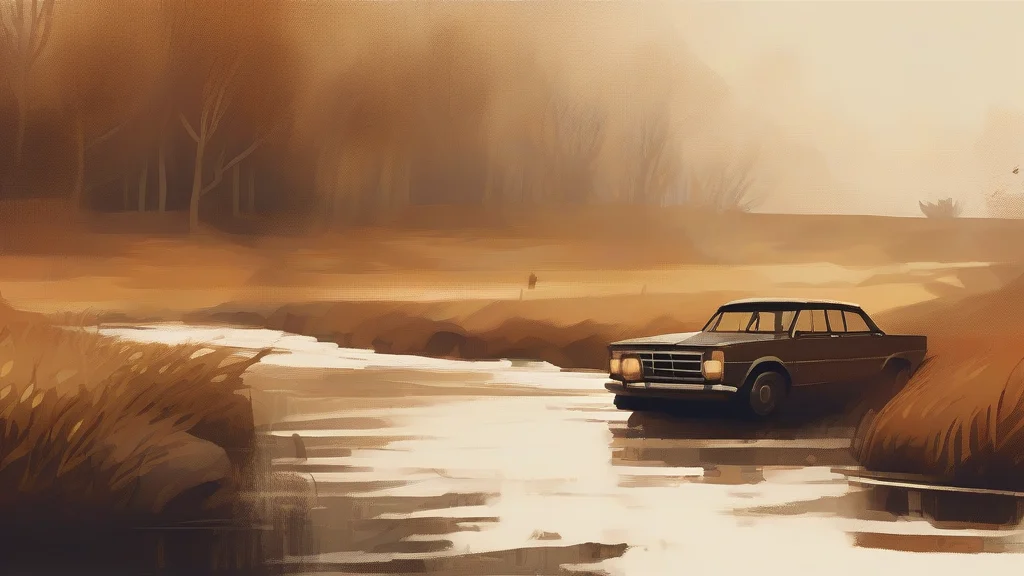
What does bourne mean?
Bourne is a noun with two related strands of meaning: a small stream, especially a seasonal watercourse common in the chalk hills of southern England, and, in literary usage, a boundary or limit. The word is best known today through Shakespeare — in Hamlet, death is 'the undiscovered country from whose bourn no traveller returns' — which fixed the boundary sense firmly in English literary memory. In ordinary speech, however, 'bourne' survives mostly in place-names such as Bournemouth, Eastbourne, and Basingstoke's River Bourne, all marking settlements beside streams. It carries a distinctly poetic, even antiquarian flavour: writers reach for it when they want an evocative alternative to 'stream' or 'limit,' rather than as neutral everyday vocabulary. Its twin meanings are not accidental — both trace back to an ancient Germanic root concerning boundaries, since streams often served as territorial borders.
nounA bourne is a small stream or brook, especially one that flows intermittently. In literary use, it also denotes a boundary or limit, particularly in the phrase 'the bourne of human knowledge.'
- A small stream or brook, especially one that flows only seasonally (chiefly British, southern England).
- A boundary or limit; an aim or destination (literary/archaic).
"The path followed the dry bourne down through the valley toward the sea."
"After heavy winter rain, the chalk downs were threaded with running bournes that vanished again by summer."
"He set out to push beyond every bourne that convention had drawn around his life."
Standard plural; used when referring to multiple streams or figurative limits.
"The chalk country is crossed by bournes that run only after sustained winter rain."
Shakespeare gave 'bourne' its most famous outing — Hamlet's 'undiscovered country from whose bourn no traveller returns' — and it still means both a stream and the edge of the known world.
Reviewed by Deb Chak, Editor. AI-assisted content curated by RJS Tech Solutions LLP.
Etymology of bourne
Bourne comes from Old English 'burna' or 'burne,' meaning a stream or spring, from Proto-Germanic '*brunō,' related to words for wells and springs; it is cognate with the Scottish and Northern English dialect word 'burn,' as in Burns's 'burns' and streams. The sense of 'boundary' developed because streams commonly marked the limits between territories, so the two meanings share a single origin rather than being separate words.
How bourne is actually used
The stream sense is chiefly British and largely confined to place-names and the chalk country of southern England, where 'bourne' streams flow only in wet seasons. The boundary sense survives almost exclusively in literary or archaic register, most famously in Hamlet's soliloquy.
Easily confused with bourne
'Borne' is the past participle of 'bear' (carried or endured), while 'bourne' is a noun meaning a stream or a boundary.