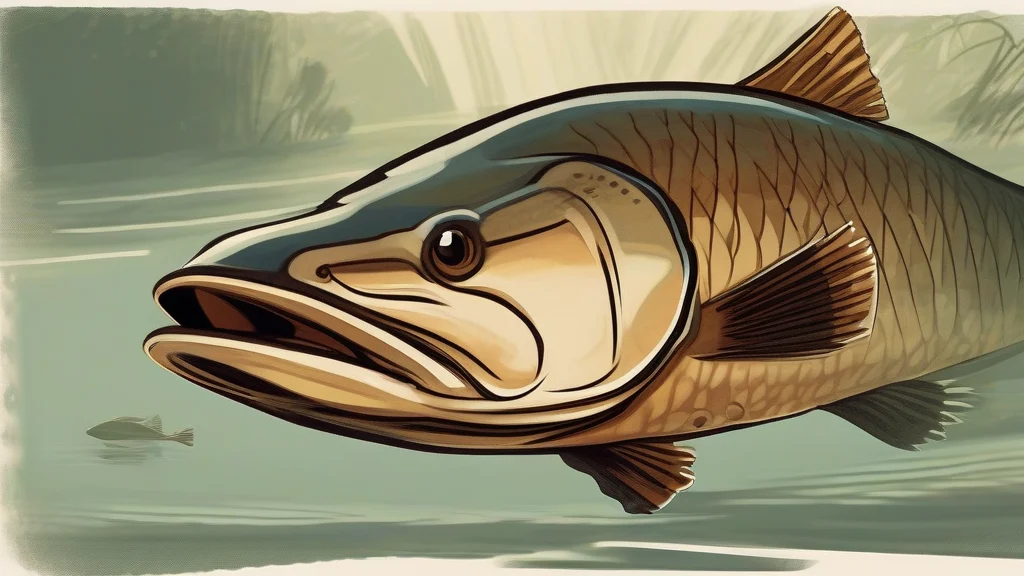
What does bowfin mean?
The bowfin is a robust, primitive freshwater fish found throughout eastern North America, from the Great Lakes down to the Gulf states. Reaching lengths of around three feet, it is easily recognized by its long, undulating dorsal fin, cylindrical body, and habit of rising to the surface to gulp air—a trait that lets it tolerate warm, oxygen-poor waters where other fish perish. The bowfin is the only surviving member of an ancient family of fishes dating back to the Jurassic period, which has earned it the label of a living fossil. Anglers know it under a variety of colorful local names, including mudfish, grindle, and cypress trout, and it is frequently caught in weedy backwaters and slow rivers. Though once dismissed as a rough fish, its firm white flesh is regarded as good eating when prepared fresh.
nounA large, primitive freshwater fish (Amia calva) native to eastern North America, having a long dorsal fin and capable of breathing air by gulping at the surface.
- A primitive air-breaching freshwater fish of eastern North America (Amia calva), the sole living member of the family Amiidae.
"The angler was surprised to haul a bowfin out of the weed-choked bayou, its long dorsal fin rippling as it thrashed."
"Fishermen often release any bowfin they catch, unaware that it makes excellent eating despite its muddy reputation."
"The bowfin is considered a 'living fossil,' virtually unchanged since the age of the dinosaurs."
Both forms occur; 'bowfin' is common as a collective or unchanged plural when speaking of the fish in general, while 'bowfins' appears when counting individuals.
"Biologists netted a dozen bowfin during the survey."
The bowfin can gulp air at the surface and survive out of water for hours—earning it the unglamorous nickname 'mudfish' from anglers who find one wriggling in their boat.
Reviewed by Deb Chak, Editor. AI-assisted content curated by RJS Tech Solutions LLP.
Etymology of bowfin
The word bowfin combines two Old English roots: 'bow' (boga), referring to something bent or arched, here describing the fish's distinctive arched, elongated dorsal fin, and 'fin.' As a compound it emerged in American English in the early nineteenth century to name this distinctly North American species. The element 'bow' also survives in words such as rainbow and crossbow.
How bowfin is actually used
The term is used chiefly in North American contexts, particularly among anglers and ichthyologists. It carries no figurative or extended senses. Regional folk names such as mudfish, grindle, and choupique (Louisiana) refer to the same species.
Easily confused with bowfin
The snakehead is an invasive air-breathing fish sometimes mistaken for the native bowfin, but the snakehead has a long continuous anal fin and scales on top of its head, unlike the bowfin's bony gular plate.