What does bowknot mean?
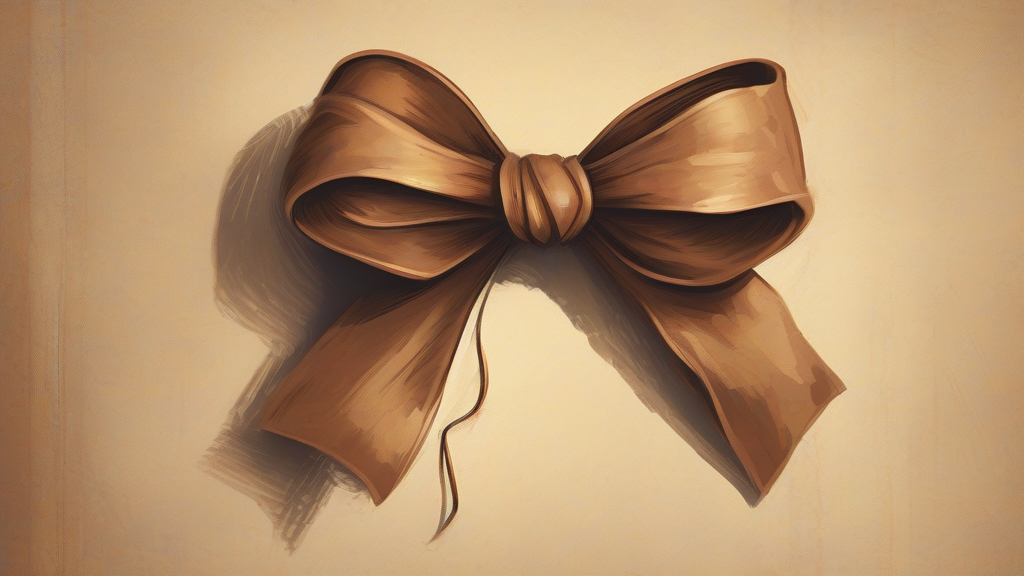
A bowknot is a decorative knot tied in a ribbon, string, lace, or cord so that it forms two symmetrical loops with loose ends hanging down, giving it the familiar silhouette of a bow. It is among the most widely recognized knots in daily life, appearing wherever gifts are wrapped, dresses are laced, hair is ribboned, or shoelaces are fastened. The word combines "bow," in the sense of a curved or doubled-over shape, with "knot," and functions only as a noun. Although most speakers simply say "bow" in casual speech, "bowknot" carries a slightly more precise, formal flavor and shows up frequently in fashion writing, sewing patterns, craft instructions, and product descriptions. Its connotations are gentle and ornamental rather than rugged — unlike a sailor's working knots, the bowknot exists chiefly to please the eye while remaining easy to untie. For anyone describing clothing, packaging, or handiwork with care, it is a useful and exact term.
nounA decorative double-looped knot tied in a ribbon, string, or lace, resembling the shape of a bow. It is also used more generally for any ornamental knot of this kind.
- A decorative knot tied in ribbon, string, or lace so that it forms two symmetrical loops and two loose ends, resembling a bow.
- Any ornamental or functional knot of this looped form, such as the one formed when tying shoelaces.
"She finished the gift with a red satin bowknot and a handwritten tag."
"The bride's gown was fastened at the back with an elegant white bowknot."
"He showed his daughter how to tie her shoes using a simple bowknot."
Standard regular plural, used when referring to multiple such knots, e.g. on garments or decorations.
"Her cardigan was trimmed with little pearl buttons and matching bowknots."
That neat little loop on your shoelaces has its own name — the bowknot — and it's been dressing up gifts, gowns, and hair ribbons for centuries.
Reviewed by Deb Chak, Editor. AI-assisted content curated by RJS Tech Solutions LLP.
Etymology of bowknot
Bowknot is a straightforward English compound formed from "bow" and "knot," both long-established native words traceable to Old and Middle English. The element "bow" here derives from Old English "būgan," meaning to bend, the same root that gives us "bend"-related words such as "elbow" and "rainbow." The compound arose naturally as English speakers needed a name for the characteristic double-looped knot tied in ribbons and laces, and it has remained in steady use in dressmaking, haberdashery, and general description since at least the early modern period.
How bowknot is actually used
"Bowknot" is slightly more formal or technical than the everyday word "bow"; in ordinary conversation people almost always say "bow." It appears most often in contexts of dressmaking, gift wrapping, fashion description, and crafts. The plural is "bowknots."
Easily confused with bowknot
A bough is a main branch of a tree, while a bowknot is a looped decorative knot tied in ribbon or cord.