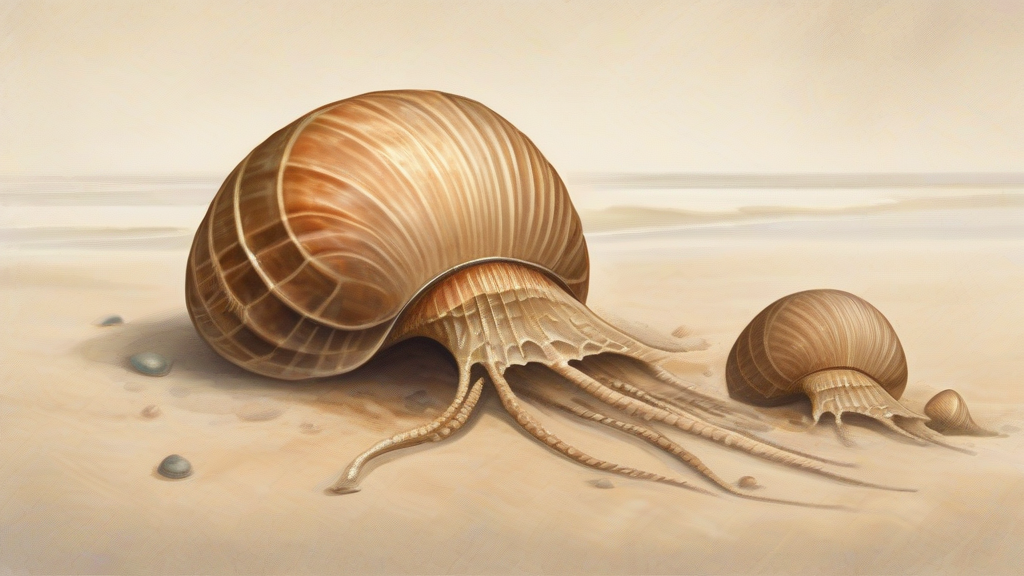
What does brachiopod mean?
A brachiopod is a marine invertebrate belonging to the phylum Brachiopoda, an ancient group of animals that live attached to the sea floor inside a shell made of two parts known as valves. Unlike the familiar bivalve molluscs such as clams and mussels, whose valves are mirror images on the left and right sides of the body, a brachiopod's valves are of different sizes and sit one above the other — a larger ventral valve below and a smaller dorsal valve above. Most brachiopods anchor themselves by means of a fleshy stalk called a pedicle, and they feed by drawing water through a ciliated organ called a lophophore. The group flourished spectacularly during the Palaeozoic era; fossil brachiopods are among the most common index fossils used to date sedimentary rocks. Today far fewer species survive, but the word remains standard in palaeontology, geology, and museum interpretation.
nounA marine invertebrate animal of the phylum Brachiopoda, having a shell of two unequal halves (valves), one dorsal and one ventral, and a ciliated feeding organ called a lophophore. Though they superficially resemble bivalve molluscs, brachiopods are only distantly related to them.
- Any marine invertebrate of the phylum Brachiopoda, characterized by two shell valves (one dorsal, one ventral) and a lophophore used for filter feeding.
"The limestone cliffs were packed with the fossilised shells of ancient brachiopods."
"Palaeontologists identified over a dozen species of brachiopod in the shale layer."
"Unlike clams, a living brachiopod attaches itself to the sea floor by a fleshy stalk called a pedicle."
Regular English plural, formed by adding -s.
"Fossil brachiopods are so plentiful that entire limestone beds are composed of their shells."
Brachiopods were so abundant in ancient seas that some Palaeozoic rock formations are made almost entirely of their shells — yet today most people have never heard of them.
Reviewed by Deb Chak, Editor. AI-assisted content curated by RJS Tech Solutions LLP.
Etymology of brachiopod
The word 'brachiopod' derives from modern Latin Brachiopoda, the name of the phylum, which was formed from Ancient Greek elements: brakhíōn meaning 'arm' and poús (stem pod-) meaning 'foot', referring to the arm-like lophophore feeding appendages once thought related to the foot-like pedicle. The same Greek roots appear in English words such as 'brachial' (of the arm) and 'podium' or 'podiatry' (from the root for foot). The term entered English scientific usage in the early nineteenth century as naturalists formalized the classification of these shelled marine animals.
How brachiopod is actually used
Brachiopod is a technical term used chiefly in palaeontology, zoology, and geology; it is rare in everyday speech but common in scientific writing and museum contexts. The informal name 'lamp shell' refers to the resemblance of some shells to ancient oil lamps. The plural is simply 'brachiopods'.
Easily confused with brachiopod
A bivalve is a mollusc whose two shell valves are typically left and right (mirrored) halves, whereas a brachiopod's valves are dorsal and ventral — one above the other.