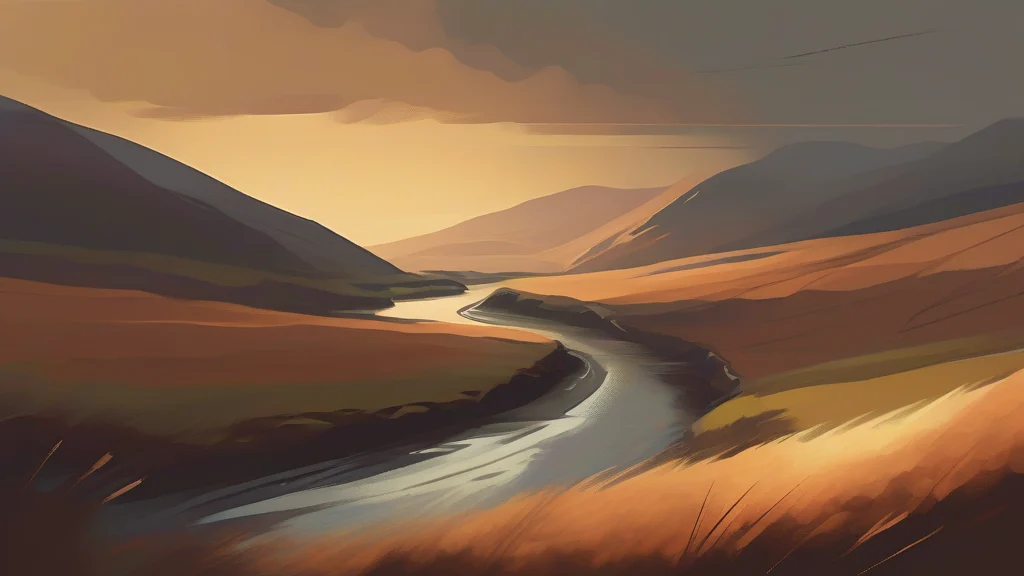
What does brae mean?
A brae is a hillside or slope — most often a grassy incline — and the word belongs firmly to the vocabulary of Scotland and northern England. In Scots usage it can denote anything from a gently rising pasture to the steep bank of a river, and it survives robustly in everyday speech north of the border as well as in countless place names such as the braes of Angus or Burnside Brae. Because it evokes rolling upland landscapes, brae carries a warm, pastoral connotation and is a favourite of poets and travel writers seeking local colour. The word derives from the Old Norse brá, meaning brow or eyelid, brought by Scandinavian settlers and sharing a distant root with the English word brow. For readers outside Britain it offers an evocative, precisely regional alternative to plain words like slope or hillside.
nounA slope or hillside, especially a grassy one; in Scottish and Northern English usage, the steep bank of a river or the side of a hill.
- A hillside or slope, especially a grassy one.
- A riverbank or steep bank, especially in Northern English usage.
"They climbed the brae behind the village to watch the sunset over the firth."
"The sheep grazed contentedly on the sunlit brae above the croft."
"Children raced their sledges down the snowy brae at the edge of town."
Regular plural; commonly used in Scottish place names and landscape descriptions.
"The path winds through the braes above the loch."
"Brae" is what you get when Vikings settle Scotland — it comes straight from the Old Norse word for "brow," so every Scottish brae is literally the land's eyebrow.
Reviewed by Deb Chak, Editor. AI-assisted content curated by RJS Tech Solutions LLP.
Etymology of brae
Brae entered Scots and Northern Middle English from Old Norse brá, meaning brow or eyelid, carried by Scandinavian settlers who colonised much of northern Britain in the early medieval period. It thus shares a common Germanic root with the English word brow, both descending from the Proto-Germanic term for the brow or ridge above the eye, extended metaphorically to the brow of a hill. The word has remained in continuous use in Scots for centuries and is well established in Scottish place names and literature.
How brae is actually used
Brae is chiefly Scottish and Northern English, and carries a distinctly regional, somewhat literary or nostalgic flavour when used elsewhere. It typically refers to gentle grassy slopes as well as steeper hillsides, and appears frequently in place names and poetry.
Easily confused with brae
Bray is the loud harsh cry of a donkey (or to make such a sound), whereas brae is a noun meaning a hillside or slope.