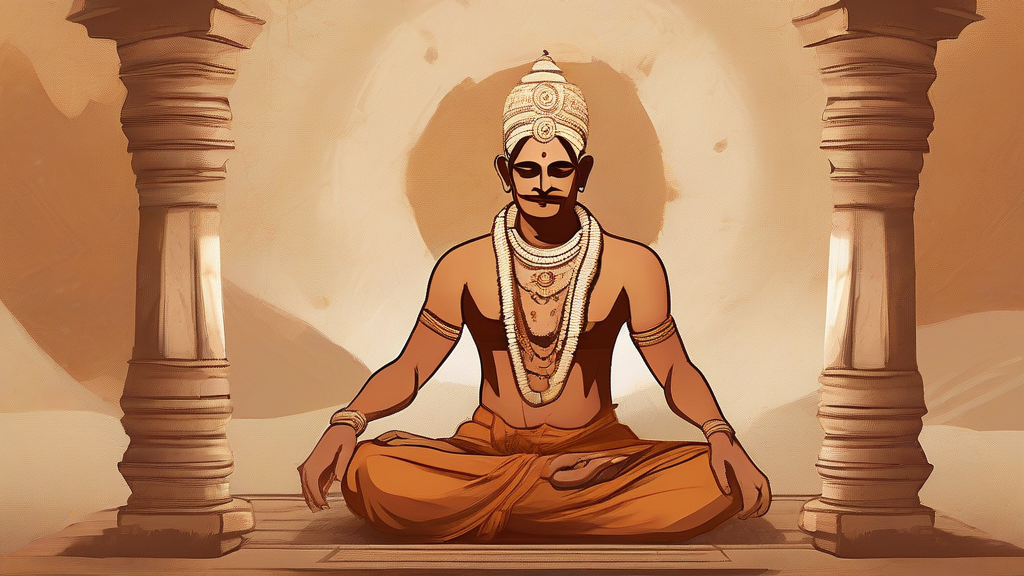
What does brahmanism mean?
Brahmanism is a noun denoting the religious and social system of ancient India in which the Brahmins — the hereditary priestly class — held supreme ritual and intellectual authority. Centered on the Vedas, it emphasized elaborate sacrificial ceremonies, strict rules of purity, and a social order organized by caste. The term is chiefly historical and academic: scholars use it to describe the dominant orthodox religion of the early first millennium BCE, against which Buddhism and Jainism defined themselves in reaction. In broader usage it can also refer to adherence to Brahminical doctrine within Hinduism more generally. Because the word evokes priestly privilege and rigid hierarchy, it carries a somewhat formal, sometimes critical tone. Related spellings include "Brahminism." Though rooted in the past, Brahmanism remains an important term for understanding how classical Hindu thought, ritual, and social structure took shape over centuries of development.
nounThe religious and social system of ancient India centered on the Brahmins (priestly class), characterized by Vedic ritual, caste distinctions, and the authority of priestly tradition; also, more broadly, the beliefs and practices associated with Hinduism as shaped by Brahmin orthodoxy. It is often contrasted in scholarly writing with later Buddhist and heterodox movements.
- The ancient Vedic religion of India dominated by the Brahmin priesthood, with its rituals, sacrificial practices, and social order based on caste.
- More generally, adherence to or advocacy of the doctrines and authority of the Brahmins within Hinduism.
"The rise of Buddhism in the sixth century BCE posed a direct challenge to the authority of Brahmanism."
"Early Buddhist texts frequently criticize the sacrificial rites central to Brahmanism."
"Max Müller's comparative studies traced the evolution of Brahmanism into classical Hinduism."
Rarely pluralized; used only when referring to multiple distinct varieties or historical phases of the system, typically in academic writing.
"Scholars distinguish several regional brahmanisms across early Indian history."
"Brahmanism" is what scholars call the ancient priest-dominated religion of India before Buddhism pushed back — and its name comes not from a god but from the priestly class itself.
Reviewed by Deb Chak, Editor. AI-assisted content curated by RJS Tech Solutions LLP.
Etymology of brahmanism
The word derives from "Brahman" (or "Brahmin"), the Sanskrit term for the priestly class of ancient India, combined with the suffix "-ism" to form a name for their religious system. The root ultimately traces to Sanskrit brāhmaṇa-, relating to the sacred texts known as the Brāhmaṇas and to brahman, the ultimate cosmic principle in Hindu philosophy. The term entered English through European scholarship on Asian religions during the eighteenth and nineteenth centuries.
How brahmanism is actually used
A scholarly and historical term rather than one used in everyday speech; some modern writers prefer "Brahminism," though both spellings are accepted. Because it can carry connotations of priestly orthodoxy and caste hierarchy, it is best reserved for historical or academic contexts rather than as a synonym for contemporary Hinduism.
Easily confused with brahmanism
Brahmanism refers specifically to the older, Vedic and priest-centered religion of ancient India, whereas Hinduism is the broader modern term encompassing many traditions that developed from it.
Buddhism arose partly in opposition to Brahmanism's priestly authority and caste system, so the two terms denote distinct religions despite their shared Indian origin.