
What does brailed mean?
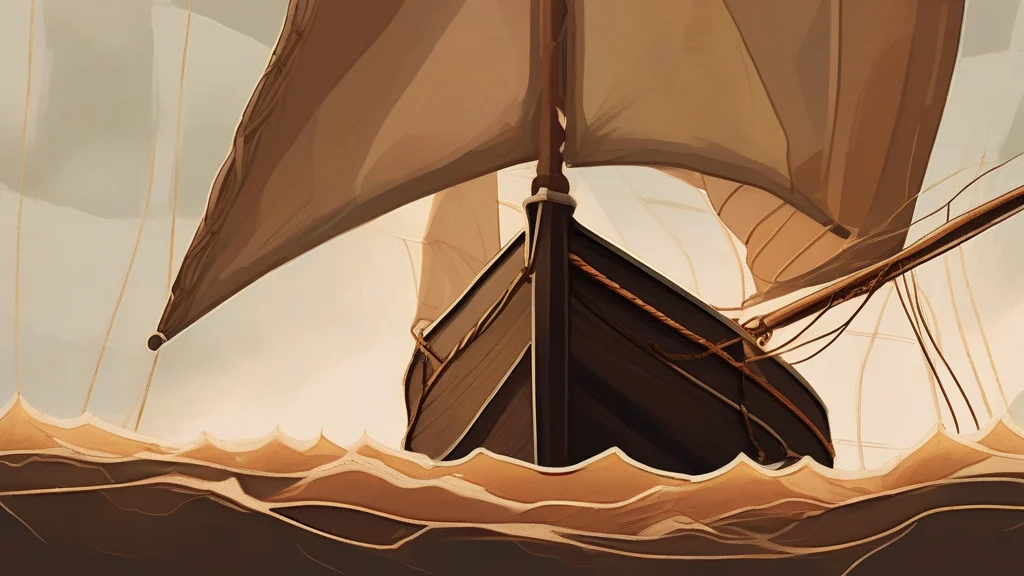
Brailed is the past tense and past participle of brail, a nautical verb meaning to haul in or furl a sail by means of brails — light ropes led through rings or blocks along a sail's outer edge so that pulling them gathered the canvas up against the yard or mast. The technique was common aboard gaff-rigged boats, lateen rigs, and small working craft, where it allowed a crew to reduce or stow sail quickly without going aloft. A phrase like 'the skipper brailed the mizzen as the wind rose' places the word firmly in the world of traditional seafaring. Today brailed survives mostly in sailing manuals, maritime history, and fiction about the age of sail, giving it a deliberately old-fashioned, salty register. It should not be confused with Braille, the tactile writing system, which is an entirely unrelated word.
verb (past tense and past participle of 'brail')Hauled in or furled (a sail) by means of brails — small ropes running through blocks along the leech of a sail used to gather it up toward the mast.
- To have hauled in or furled a sail using brails (small ropes attached to a sail's leech and passed through leads toward the mast).
"The crew brailed the foreskin quickly as the squall bore down on the small sloop."
"The fishermen brailed the net's sail as they came about in the stiff breeze."
"By dusk every sail had been brailed and secured, and the deck lay quiet under a grey sky."
Before winches and roller furling, sailors 'brailed' their sails home by yanking ropes threaded up the sail's edge — a word as old as square rig itself.
Reviewed by Deb Chak, Editor. AI-assisted content curated by RJS Tech Solutions LLP.
Etymology of brailed
The noun brail, from which brailed derives, entered English in the fifteenth century from Middle English, likely via Anglo-French 'brail' or Old French 'brayer', ultimately connected to Celtic roots relating to a strap or thong. The verb followed naturally once the rigging term was established. Its relatives in other languages remain limited, and the modern sense has been stable since the days of early modern seafaring.
Related word forms
How brailed is actually used
'Brailed' belongs almost entirely to historical and specialist nautical vocabulary; outside sailing literature, dictionaries of seamanship, and accounts of traditional craft, it is rare. It appears mainly as the past tense ('they brailed the sail') or past participle ('the sail was brailed up').
Easily confused with brailed
'Brailed' is the past tense of the nautical verb 'brail' (to furl a sail), whereas 'Braille' refers to the raised-dot writing system for blind readers, whose verb form is usually written 'brailled' in British English.