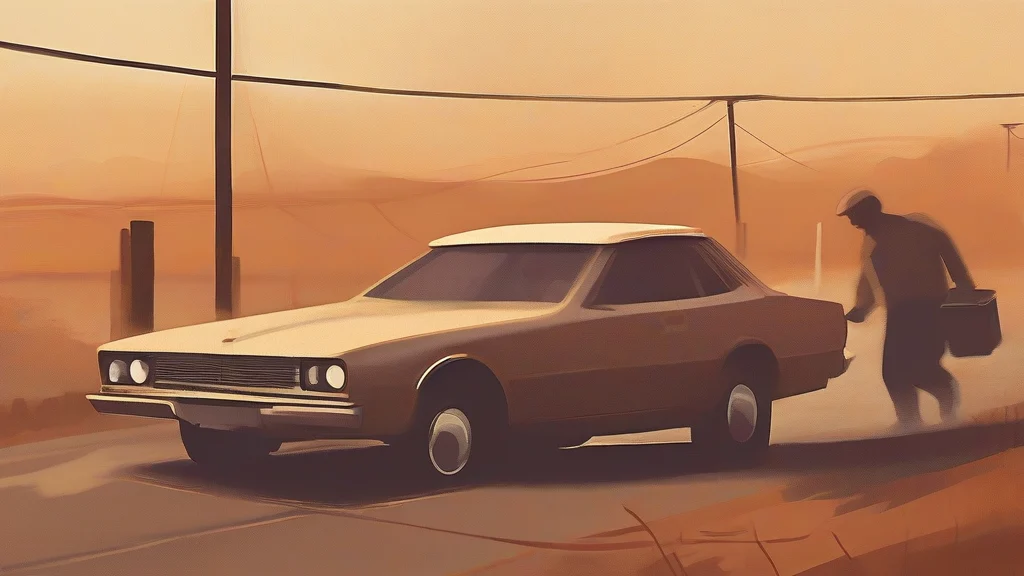
What does braked mean?
"Braked" is the past tense and past participle of the verb "brake," meaning to slow down or bring a vehicle, bicycle, train, or machine to a stop by engaging its braking mechanism. It is an ordinary but essential word of everyday movement: drivers braked at traffic lights, cyclists braked on steep descents, trains braked as they approached platforms. The word carries no strong connotation of its own — its tone comes entirely from context, so it can describe anything from a gentle deceleration ("she braked smoothly for the roundabout") to an emergency maneuver ("he braked hard to avoid the collision"). Common collocations include "braked hard," "braked sharply," and "braked suddenly." Writers should be careful not to confuse it with "broke," the past tense of "break"; the vowel spelling marks the difference. The noun "brake" itself may derive from the same root as "break," reflecting how early stopping devices pressed against or broke the motion of wheels. Simple, functional, and universally understood, "braked" belongs to the core vocabulary of anyone writing about travel, transport, or motion.
verbPast tense and past participle of the verb "brake": slowed down or stopped a vehicle or machine by applying a braking mechanism.
- To have slowed or stopped a vehicle or machine by applying its brakes.
"She braked suddenly when a deer darted across the road."
"He braked hard to avoid the cyclist who had swerved into his lane."
"The train braked gently as it glided into the station."
The verb "brake" likely grew out of the same idea as "break" — early brakes literally broke or pressed against wheels to stop them.
Reviewed by Deb Chak, Editor. AI-assisted content curated by RJS Tech Solutions LLP.
Etymology of braked
The verb "brake" comes from the English noun "brake," meaning a device for stopping a wheel or machine, which is first recorded in the late eighteenth century. Its origin is uncertain, though many lexicographers connect it to "break," since early braking devices stopped wheels by pressing against them or breaking their motion. The word has no widely cited foreign cognates, making it a distinctly English development within the vocabulary of transport.
Related word forms
How braked is actually used
"Braked" appears almost exclusively in driving, cycling, rail, and machinery contexts. It is neutral in register and standard in both British and American English; note that the spelling distinguishes it from "broke," a common slip in informal writing.
Easily confused with braked
"Broke" is the past tense of "break" (to shatter or become insolvent), while "braked" is the past tense of "brake" (to slow or stop a vehicle).
"Brake" as a noun refers to the stopping mechanism itself, whereas "braked" is the verb form describing the act of using that mechanism.