
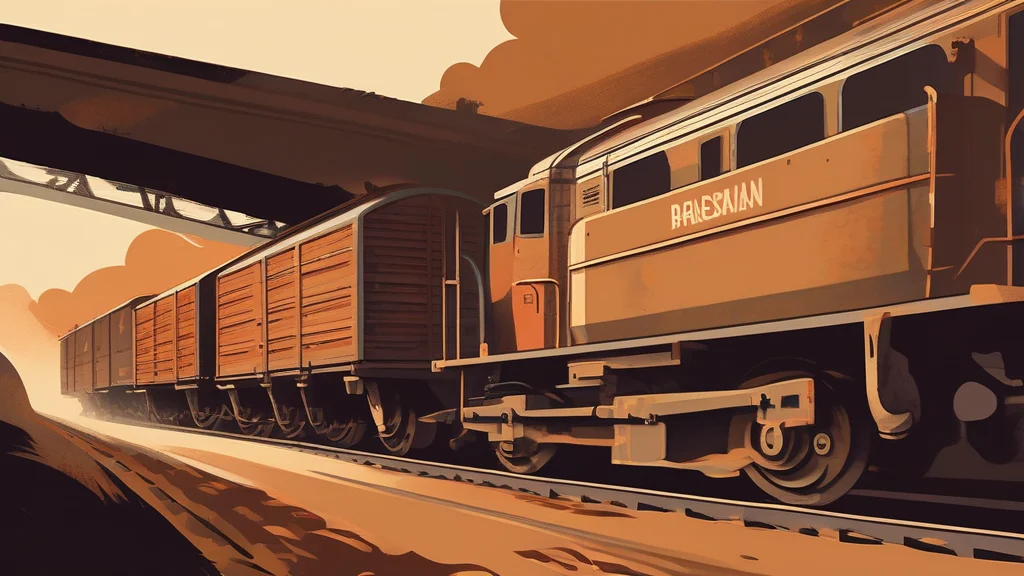
What does brakesman mean?
A brakesman is a worker whose duty is to operate the brakes of a vehicle, most commonly a railway train. The term belongs largely to the history of British rail transport: before the widespread adoption of continuously braked trains and automatic air brakes, freight and passenger trains relied on individual hand-operated brakes, each tended by a brakesman stationed in a brake van or wagon. By screwing down or releasing these manual brakes on signal, brakesmen controlled the train's speed, particularly on steep gradients, and coordinated their efforts with the driver. The role demanded alertness, strength, and precise timing, since an error could cause wagons to bunch or run away. The plural form is 'brakesmen', and the closely related American equivalent is 'brakeman'. Today the word survives mainly in historical writing, railway heritage contexts, and accounts of Victorian and early twentieth-century working life, evoking an era when stopping a train was a skilled, physical, and genuinely dangerous craft rather than the simple press of a lever.
nounA person whose job is to operate the brakes of a railway train or other vehicle, especially in the era before continuous automatic braking systems.
- A railway worker responsible for operating a train's brakes, especially historically on goods trains where each wagon or brake van had its own hand-operated brake.
- More broadly, anyone employed to apply or tend the brakes of a vehicle or machine.
"In the age of steam, every goods train relied on a brakesman stationed at the rear van."
"The brakesman climbed into the brake van and screwed down the hand brake as the goods train began its descent."
"His grandfather worked as a brakesman on the railways for over thirty years."
Regular masculine-agent plural in '-men'; used when referring to multiple workers in the role.
"The company hired several new brakesmen for the busy mineral line."
Before air brakes existed, stopping a freight train took a whole crew of brakesmen spinning hand wheels in wagons down its length.
Reviewed by Deb Chak, Editor. AI-assisted content curated by RJS Tech Solutions LLP.
Etymology of brakesman
The word is a compound of 'brake', meaning a device for slowing or stopping a mechanism, which entered Middle English possibly from a Germanic source related to breaking or from the Late Latin 'braca'; and 'man', from Old English 'mann'. It was formed in Britain during the nineteenth century as railways spread and specialized roles emerged for workers who manually operated wagon brakes. Its American counterpart 'brakeman' shows the same transparent formation, reflecting how both national railway cultures named the trade directly after its defining task.
Related word forms
How brakesman is actually used
The word is largely historical and technical, associated with British railway terminology of the steam era. The plural is 'brakesmen'. In American English, 'brakeman' is the usual equivalent term.
Easily confused with brakesman
'Brakeman' is the more common American term for the same role, while 'brakesman' is chiefly British and historical.