
What does brambling mean?
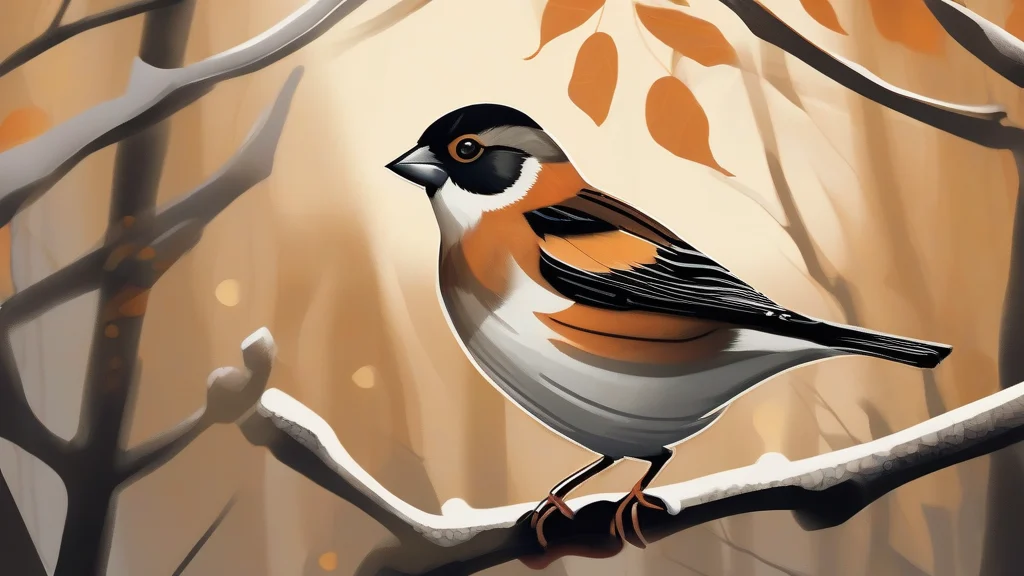
The brambling (Fringilla montifringilla) is a Eurasian finch best known to birdwatchers as a winter visitor that breeds across northern Scandinavia and Russia and moves south and west in autumn. Roughly the size of a chaffinch, its close relative, it shows striking seasonal plumage: breeding males are bold combinations of black head and back, warm orange breast and shoulders, and white underparts, while winter birds are duller and heavily streaked. Its English name reflects its habit of feeding around bramble thickets and hedgerows. Bramblings typically forage on the ground for beech mast and other seeds, often forming huge mixed flocks with chaffinches, sometimes numbering thousands of birds. In North America they appear only rarely, most often in Alaska, making them a prized find there. For naturalists, the word carries a pleasantly seasonal ring, evoking cold-weather woodland walks rather than everyday speech.
nounA brambling is a Eurasian finch (Fringilla montifringilla), the male strikingly marked in black, orange, and white, which breeds in northern birch forests and winters southward in large flocks, often alongside chaffinches.
- A Eurasian finch (Fringilla montifringilla) with orange-and-black breeding plumage in the male, breeding in northern birch and conifer forests and wintering in large flocks farther south and west.
"A flock of bramblings descended on the beech woods, noisily searching for mast among the leaf litter."
"Birdwatchers gathered at dawn hoping to spot a brambling among the wintering chaffinches."
"In hard winters, bramblings pour into southern England in search of beech mast."
Regular plural; used when referring to multiple birds or to the species collectively in counts.
"Thousands of bramblings roosted in the pine plantation overnight."
Named after bramble bushes it feeds around, this Scandinavian-breeding finch can descend on British beechwoods in winter flocks numbering in the tens of thousands.
Reviewed by Deb Chak, Editor. AI-assisted content curated by RJS Tech Solutions LLP.
Etymology of brambling
The name brambling derives from 'bramble', the prickly shrub, combined with the agent-noun ending '-ing', a formation reflecting the bird's habit of feeding among brambles and hedgerow vegetation; the usage is recorded from at least the early modern period. The species belongs to the genus Fringilla alongside the chaffinch, and the scientific epithet montifringilla means 'mountain finch' in Latinized form. Related vernacular names exist in other European languages, but the English word's lineage is straightforwardly native, built from Old English 'bræmbel' (bramble).
How brambling is actually used
Primarily used in ornithological and birdwatching contexts; familiar to British birders, less so to general American readers, though the species occasionally appears in Alaska as a rare visitor. The plural is simply 'bramblings'.
Easily confused with brambling
A bramble is a prickly shrub such as a blackberry bush, whereas a brambling is a species of finch.
The chaffinch (Fringilla coelebs) is a closely related but distinct finch; bramblings often mix with chaffinch flocks in winter but differ in plumage and migration pattern.