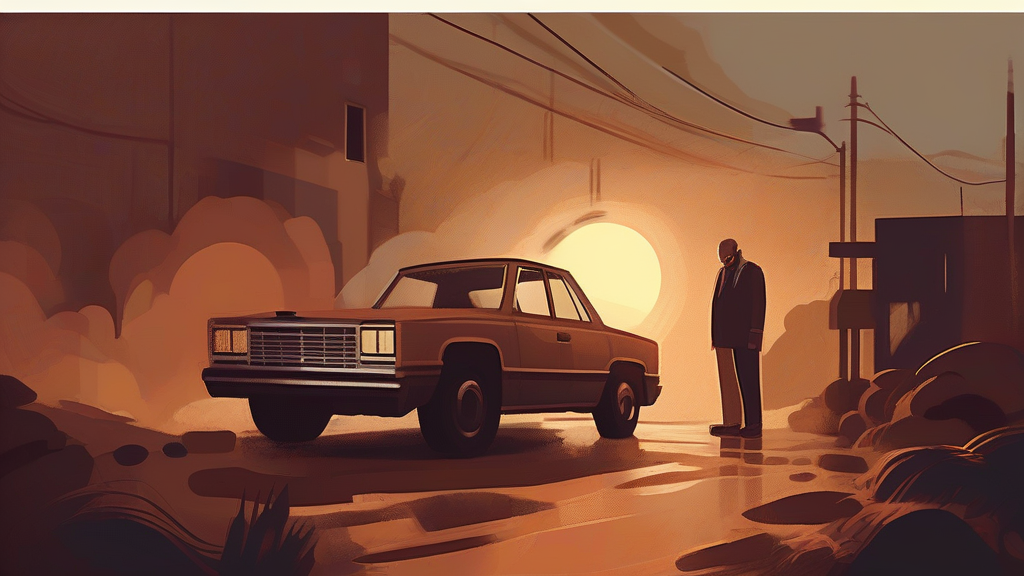
What does breakdown mean?
Breakdown is a versatile English noun with several related senses. Most literally, it refers to the failure of a machine, vehicle, or system to work: a car's breakdown leaves you stranded, and a breakdown in communications derails negotiations. By extension it describes a sudden collapse of a person's mental health, as in the familiar phrase 'nervous breakdown', though this usage now sounds informal and slightly dated compared with clinical language. A third, quite different sense is analytical: a breakdown is a detailed, itemized division of a whole into its parts, such as a breakdown of costs, votes, or demographics, making it a staple word in business, finance, and journalism. Formed from the verb phrase 'break down', the closed compound emerged in English in the nineteenth century. Its connotations range from inconvenient to alarming depending on context, yet its analytical sense carries no negative charge at all. Few nouns move so comfortably between the garage, the therapist's office, and the boardroom.
A failure of a machine, vehicle, system, or process to function; a mechanical or operational stoppage.
"The train service was disrupted by a signalling breakdown."
Often used with 'suffer' or 'experience'.
A sudden collapse of a person's mental health, typically rendering them unable to cope with daily life.
"The pressure of the campaign finally led to a breakdown."
Usually in the fixed phrase 'nervous breakdown'; considered informal and dated in clinical settings.
An itemized analysis or classification of a whole into its constituent parts or categories.
"The report includes a breakdown of expenditure by department."
A failure of communication, talks, or a relationship between parties.
"Negotiations ended after a complete breakdown in trust."
Regular plural; standard in both British and American English.
"The fleet recorded fewer breakdowns this year than last."
One word, two very different emergencies: your car can have one, and so can you — but only one of them comes with an itemized invoice.
Reviewed by Deb Chak, Editor. AI-assisted content curated by RJS Tech Solutions LLP.
Etymology of breakdown
Breakdown originated as the verb phrase 'break down', composed of the native Old English verbs 'break' and 'adverbial 'down'. The phrase was fused into a single compound noun during the nineteenth century, when it came to denote mechanical failure, and its sense later extended to mental collapse and to itemized analysis. It shares its roots with other native English compounds built on 'break', such as 'breakthrough', 'outbreak', and 'daybreak'. Because it derives from Germanic rather than Latin or Greek roots, its true cognates are found in other Germanic languages' words for breaking rather than in Romance vocabulary.
How breakdown is actually used
Register is neutral across all senses. In the mental-health sense, 'breakdown' and especially 'nervous breakdown' are somewhat dated and informal; clinical contexts prefer terms like 'mental health crisis'. The analytical sense ('a breakdown of costs') is common in business, finance, and statistics.
Easily confused with breakdown
'Break down' is the two-word verb phrase meaning to stop functioning or dismantle, while 'breakdown' (one word) is the noun naming the failure or the analysis itself.