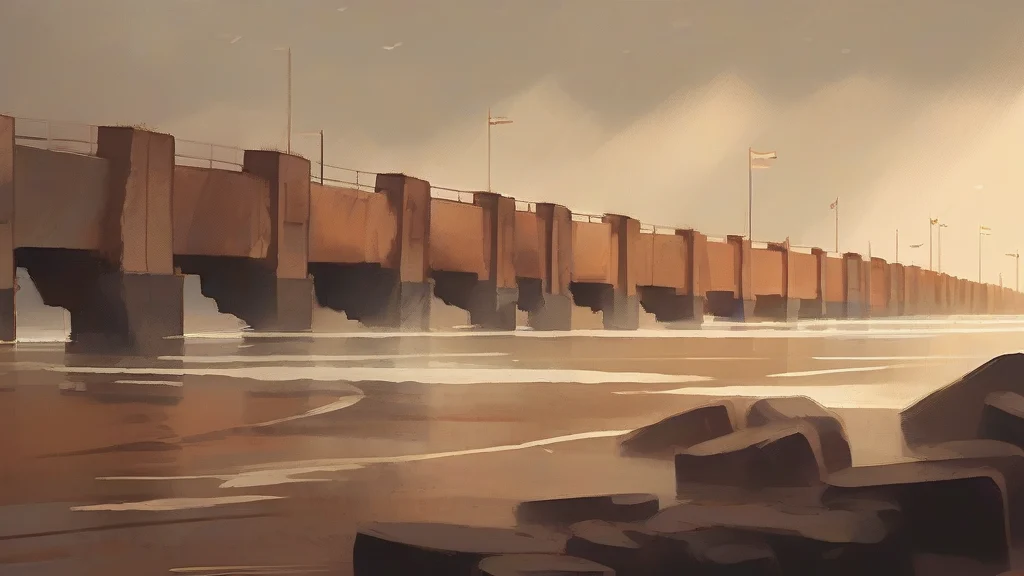
What does breakwater mean?
A breakwater is a substantial barrier, usually of stone, concrete, or rubble, built out from the shore or entirely offshore with the purpose of shielding a harbour, anchorage, beach, or stretch of coastline from the destructive power of waves. By intercepting incoming swell before it reaches sheltered water, a breakwater reduces wave height inside the protected area, making moorage safer for vessels and limiting erosion of the shore behind it. The term is most at home in maritime engineering, port planning, and coastal geography, where specialists distinguish breakwaters from related structures such as seawalls, which run along the land itself, and jetties or groynes, which serve different purposes. Breakwaters may be massive rubble-mound constructions armoured with enormous interlocking concrete units, or vertical walls of poured concrete; some are even floating. The word is transparently formed from the verb 'break' and the noun 'water', describing exactly what the structure does: it breaks the force of the water.
nounA barrier built out into the sea, a lake, or a river to protect a harbour, beach, or shore from the force of waves.
- A structure constructed offshore, typically of rock, concrete, or rubble, designed to absorb and deflect wave energy in order to protect a harbour, anchorage, beach, or shoreline.
"The new breakwater sheltered the fishing boats from the winter storms."
"Engineers anchored the floating breakwater offshore to calm the waters inside the marina."
"Over the centuries, the ancient stone breakwater at Caesarea slowly sank beneath the waves."
Regular plural. Common when discussing multiple structures along a coastline or across different ports.
"Along this coast, a chain of artificial breakwaters protects the small fishing villages from Atlantic storms."
Some breakwaters are made of nothing but millions of tonnes of carefully stacked concrete tetrapods — four-legged blocks so heavy each one can weigh as much as a fully loaded Boeing 747.
Reviewed by Deb Chak, Editor. AI-assisted content curated by RJS Tech Solutions LLP.
Etymology of breakwater
The word 'breakwater' is a straightforward English compound formed from the verb 'break' (Old English 'brecan', meaning to shatter or divide) and 'water' (Old English 'wæter'), literally naming a thing that breaks the water. The compound arose in English during the early modern period, when expanding maritime trade created a need for engineered harbour protection, and it has remained stable in form and meaning since. Its components are native Germanic words, so it has no classical cognates; however, many other languages have coined parallel compounds expressing the same idea, such as French 'brise-lames' and Dutch 'golfbreker', both of which likewise mean 'wave-breaker'.
How breakwater is actually used
The word is neutral in register and appears chiefly in maritime, engineering, and coastal-geography contexts. In everyday British usage it is sometimes used loosely for any large protective sea wall, though technical usage distinguishes it from structures such as groynes, jetties, and seawalls by its function of dissipating waves rather than retaining land.
Easily confused with breakwater
A seawall is typically a vertical or sloped structure running parallel to the shore to defend land from erosion and flooding, whereas a breakwater is usually an offshore barrier that absorbs wave energy before it reaches the harbour or coast.