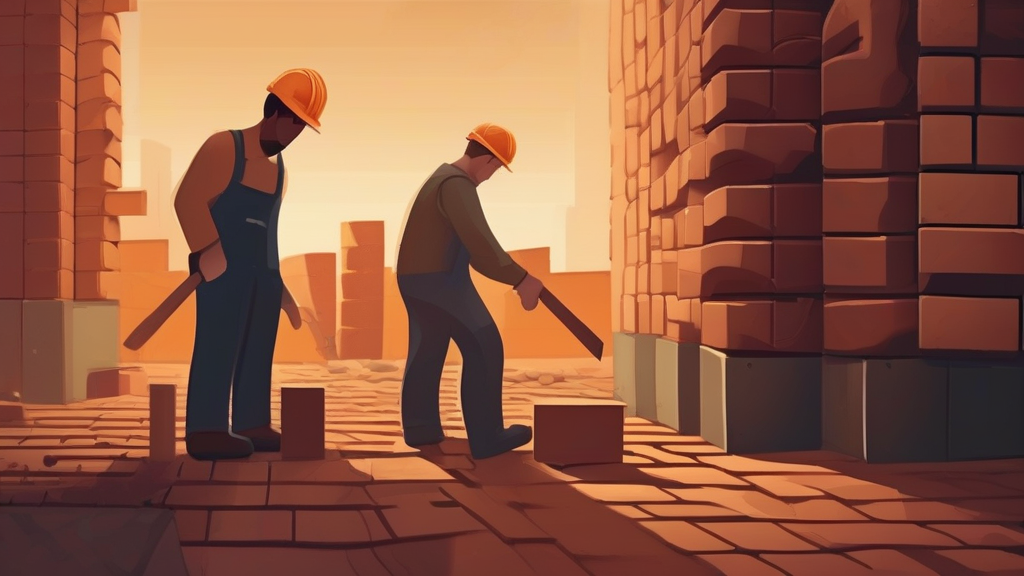
What does brickmaker mean?
A brickmaker is a person whose trade is the manufacture of bricks — shaping clay into moulds, drying the formed bricks, and firing them in a kiln to produce the durable building material used in construction worldwide. The term can refer to a manual labourer engaged in the craft, or to the owner or operator of a brickworks, the site where bricks are produced on a larger scale. Brickmaking is one of humanity's oldest industries, with fired bricks dating back thousands of years to ancient Mesopotamia, and it remained a widespread skilled trade well into the twentieth century. Today the word carries a distinctly historical and occupational flavour: it appears most often in discussions of industrial heritage, archaeology, and family history, where 'brickmaker' is a commonly recorded ancestor's profession. It should not be confused with 'bricklayer', which denotes a person who builds with bricks rather than making them.
nounA person whose trade is making bricks, typically from clay that is moulded, dried, and fired in a kiln.
- A person whose occupation is manufacturing bricks from clay or other materials.
- A person who owns or operates a brickworks (a brick-making business or factory).
"His grandfather worked as a brickmaker in the clay pits outside the town."
"The village brickmaker fired his last kiln of the season before winter set in."
"In colonial Virginia, indentured brickmakers produced the bricks for grand plantation houses like Stratford Hall."
Standard regular plural; used when referring to multiple people in the trade collectively.
"The river valley once supported dozens of small brickmakers supplying the growing city."
Every brick in the Roman Empire passed through the hands of a brickmaker — and many of those bricks still bear their makers' stamped names, two thousand years later.
Reviewed by Deb Chak, Editor. AI-assisted content curated by RJS Tech Solutions LLP.
Etymology of brickmaker
The word 'brickmaker' is a straightforward English compound of 'brick' and the agentive suffix '- maker', formed within English to denote one who makes bricks. The element 'brick' entered Middle English from Old French 'brique', likely ultimately of Germanic origin, possibly related to Middle Dutch 'bricke'. Compounds of this shape ('X-maker') were productive in Middle English, so the formation is native and transparent rather than borrowed. Cognate formations appear in other Germanic languages, such as Dutch and German equivalents built from their words for brick.
How brickmaker is actually used
The word is somewhat old-fashioned and occupational in register; modern industrial production is more often described as 'brick manufacturing'. It appears frequently in historical, archaeological, and genealogical contexts, where 'brickmaker' is a common recorded trade. The plural 'brickmakers' follows standard noun inflection.
Easily confused with brickmaker
A bricklayer builds structures by laying bricks with mortar, whereas a brickmaker manufactures the bricks themselves.