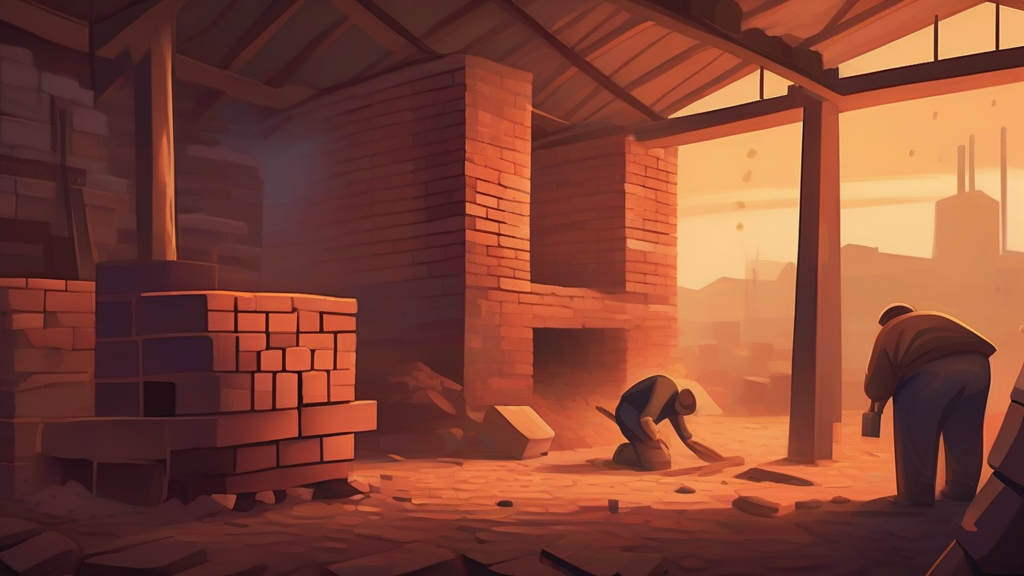
What does brickmaking mean?
Brickmaking is the noun for the process and trade of producing bricks — shaped blocks of clay that are dried and then fired in a kiln to give them hardness and durability. As an uncountable noun, it names both the craft itself and, by extension, the industry built around it: brickmaking has been practised for millennia, from sun-dried mud bricks in ancient Mesopotamia to the large-scale mechanised production of the industrial era. The word appears most often in historical, archaeological, and economic writing — accounts of local industries, heritage sites, and industrial archaeology frequently describe villages or regions whose livelihood depended on brickmaking. It carries a neutral, slightly technical register, and its connotations tend toward tradition, labour, and craftsmanship rather than glamour. Related terms such as brickyard and brickworks denote the places where the activity occurs, while bricklaying refers instead to building with the finished product — a distinction worth keeping in mind when writing about the trade.
nounThe process, trade, or industry of making bricks from clay or other materials, typically by moulding, drying, and firing them in a kiln.
- The craft, process, or commercial industry of manufacturing bricks from clay by moulding, drying, and firing them.
"The valley was once dotted with kilns, and brickmaking employed half the village."
"Brickmaking flourished along the river, where abundant clay and easy transport made the works profitable."
"He spent his apprenticeship learning brickmaking before turning to architecture."
Some of the fired-clay bricks made by ancient Mesopotamian brickmakers over 5,000 years ago are still standing — often stamped with the name of the king who ordered them.
Reviewed by Deb Chak, Editor. AI-assisted content curated by RJS Tech Solutions LLP.
Etymology of brickmaking
Brickmaking is a straightforward English compound of 'brick' plus 'making', formed within English from native word-stock. The word 'brick' itself entered Middle English from Old French 'brique', probably borrowed from a Germanic source (compare Middle Dutch 'bricke'), replacing older native terms for baked clay blocks. Compounds with '-making' were a productive pattern in English from at least the early modern period onward. Its closest relatives are simply other compounds of the same elements — words like 'bricklayer' and 'brickwork' — rather than distant cognates.
How brickmaking is actually used
A formal-to-neutral term used mainly in industrial, historical, and archaeological contexts; in everyday speech people more often say 'a brickyard' or 'a brickworks' for the place where it happens. Uncountable as a mass noun referring to the activity.
Easily confused with brickmaking
Bricklaying is the construction skill of building with finished bricks using mortar, whereas brickmaking is the manufacture of the bricks themselves.