What does bridge mean?
A bridge is a structure that carries a road, footpath, or railway across an obstacle such as a river, valley, or another road, allowing passage where nature or geography would otherwise block it. The word also names the classic four-player card game of bidding and trick-taking, as well as a range of related things: the command deck of a ship, the bony ridge of the nose, and even a short transitional passage in music. Beyond these literal uses, bridge has become one of English's favorite metaphors for connection: we build bridges between communities, bridge gaps in understanding, and speak of water under the bridge when old grievances no longer matter. The verb form means both to span something physically and to close a division figuratively. Few words so naturally unite engineering, leisure, anatomy, and human reconciliation in a single syllable-rich term that appears constantly in everyday speech.
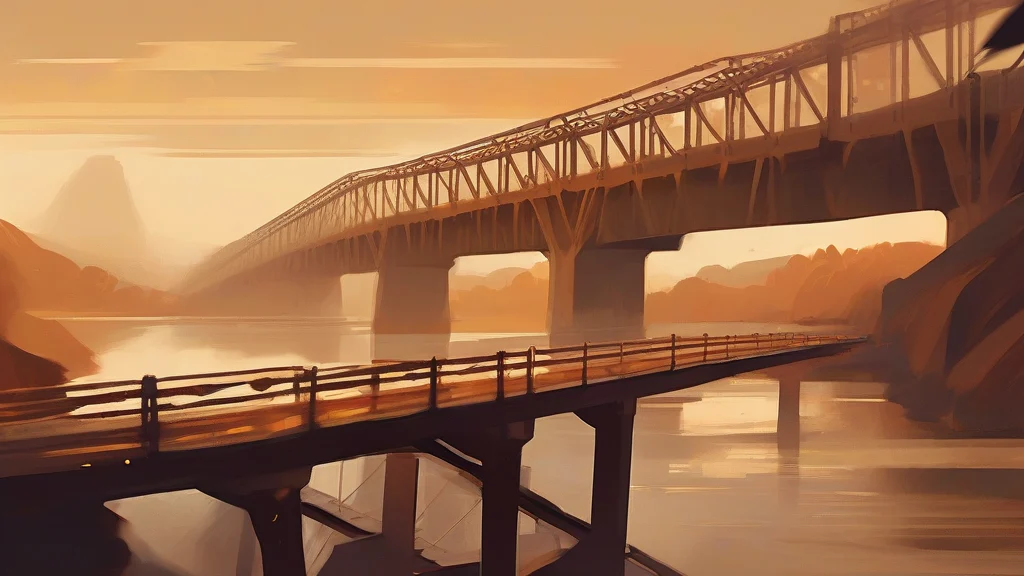
A structure built to span a physical obstacle — such as a river, valley, or road — to provide passage over it.
"The old stone bridge has stood over the river for three centuries."
A card game for four players in two partnerships, in which bids determine the contract and tricks are then played.
"My grandparents play bridge every Thursday evening."
Something that connects or provides a link between two otherwise separate things, groups, or ideas.
"Music was a bridge between their very different cultures."
The raised platform on a ship from which the officer in command navigates the vessel.
"The captain summoned him to the bridge at dawn."
Regular plural; used both literally (multiple structures) and figuratively (multiple connections). The idiom 'burning bridges' always uses the plural.
"Several of the city's oldest bridges were closed for inspection after the flood."
The phrase 'burning your bridges' comes from military strategy: destroy the crossing behind you and retreat becomes impossible.
Reviewed by Deb Chak, Editor. AI-assisted content curated by RJS Tech Solutions LLP.
Etymology of bridge
Bridge comes from Old English 'brycg', meaning a causeway or elevated roadway, from Proto-Germanic '*brugjō'. It is related to the same Germanic root that gives us 'breach' and 'break', reflecting the idea of something laid across a broken or interrupted path. The Old Norse cognate 'bryggja' meant a landing stage or quay, and Dutch 'brigge' shows the same family resemblance. The card game took its name in the late 19th century, likely via Russian 'biritch'.
Related word forms
How bridge is actually used
Both noun and verb are standard in all registers. In card-game contexts, 'duplicate bridge' and 'contract bridge' are the common formal varieties. The verb is usually used figuratively today ('bridge a gap', 'bridge differences').
Easily confused with bridge
A breach is a break or violation (as in 'a breach of contract'), while a bridge is a structure spanning an obstacle or a means of connection.