What does bridgework mean?
Bridgework is a noun referring primarily to a dental prosthesis used to replace one or more missing teeth. In dentistry, a bridge consists of artificial teeth (pontics) anchored to crowns fitted on the natural teeth or implants on either side of the gap, restoring both function and appearance. The word is formed transparently from 'bridge' plus 'work', reflecting the idea of a structure that spans an empty space and is secured at both ends. Beyond dentistry, bridgework occasionally appears figuratively to describe efforts that connect divided groups or close a gap between ideas, institutions, or people, as in diplomatic or organizational contexts. The term is somewhat formal and technical; in casual conversation speakers usually say 'dental bridge' instead. It is generally uncountable when describing the material or craft ('extensive bridgework') but can take a plural form when referring to individual appliances.
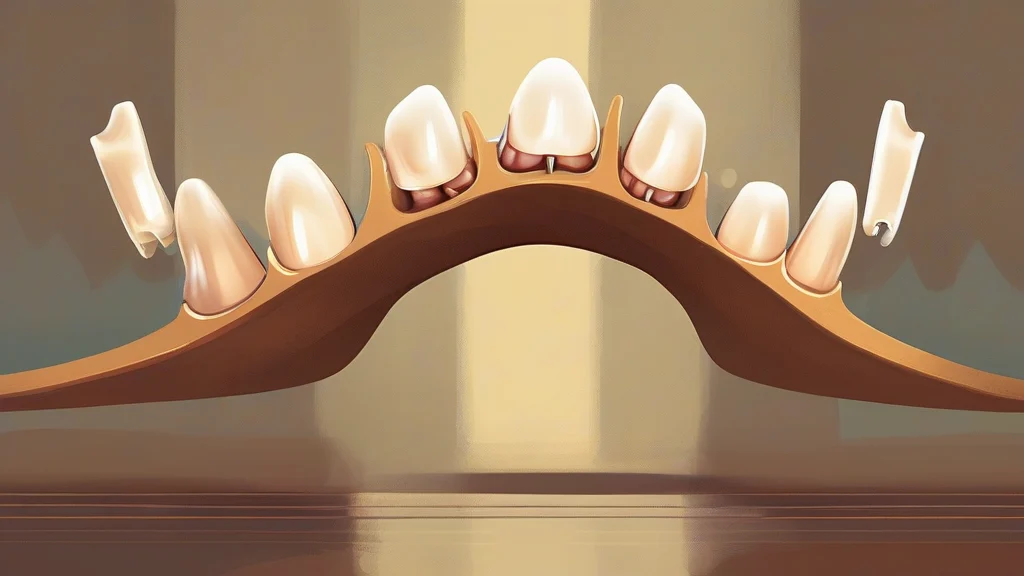
A dental appliance consisting of artificial teeth anchored to adjacent natural teeth or implants, used to replace missing teeth.
"Her bridgework was so well made that no one could tell which teeth were not her own."
Work or construction that bridges a gap or connects two separate things, especially used figuratively.
"The conference served as valuable bridgework between rival factions."
Usually uncountable when referring to dental prostheses collectively; the plural 'bridgeworks' is rare and mainly refers to multiple distinct appliances or instances of connecting work.
"The laboratory produced several bridgeworks for the clinic's patients."
Your bridgework is literally named for what it does: like its namesake over a river, a dental bridge spans a gap and anchors at both ends.
Reviewed by Deb Chak, Editor. AI-assisted content curated by RJS Tech Solutions LLP.
Etymology of bridgework
Bridgework is a compound of 'bridge', from Old English 'brycg' meaning a structure spanning an obstacle, and 'work', from Old English 'weorc' meaning labor or a constructed thing. The compound arose in English, likely in the nineteenth century, first applied to engineering structures spanning gaps and later adopted by dentistry for fixed appliances replacing missing teeth. Its Germanic roots are shared broadly across the Germanic language family, giving it cognates such as German 'Brücke' and 'Werk'.
Related word forms
How bridgework is actually used
'Bridgework' is most common in dental and medical contexts and carries a slightly formal register; in everyday speech people more often say simply 'a bridge' or 'dental bridge'. The figurative sense is rarer and typically appears in political or organizational writing.
Easily confused with bridgework
A 'bridge' can be any structure spanning a gap (including over a river) or the card game, while 'bridgework' specifically refers to a dental prosthesis or figurative connecting labor.