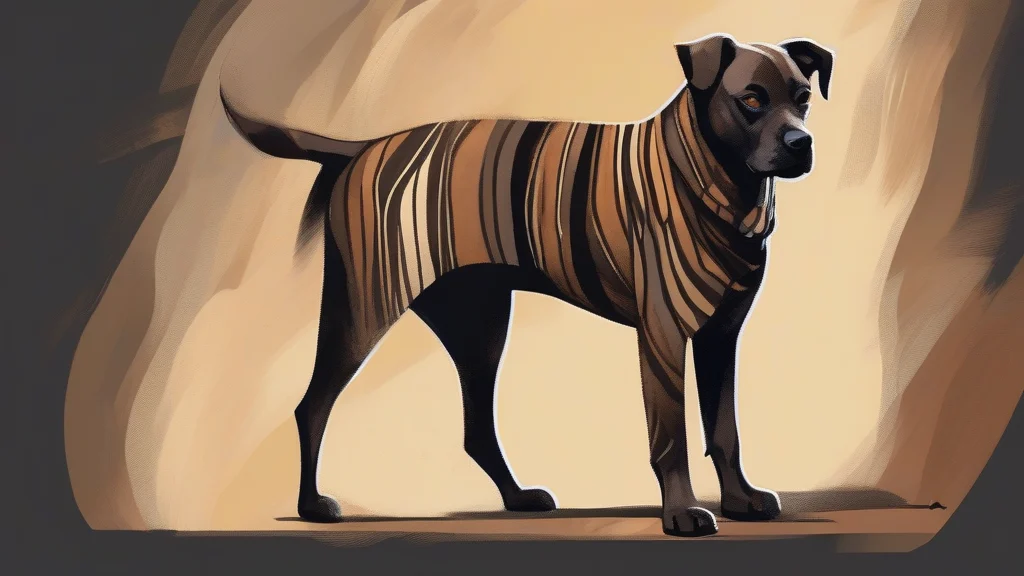
What does brindle mean?
"Brindle" describes a distinctive coat pattern in which fine, irregular streaks or stripes of a darker colour—usually black or brown—are laid over a lighter background such as fawn, tan, or grey. The word is used chiefly of domestic animals, appearing most often in descriptions of dogs such as Boxers, Greyhounds, Bulldogs, and Dutch Shepherds, as well as cats and cattle. It can function as a noun referring to the patterning itself, or attributively as in a "brindle coat," while the closely related form "brindled" serves as a straightforward adjective. In breeding and show circles the term carries precise meaning, since some breeds treat brindle as a recognised and sometimes highly prized colour variety. The word entered English in the seventeenth century, its exact origin uncertain but possibly connected to an older term meaning scorched or burnt, which fits the smudged, fire-tinged look of the pattern. Vivid and evocative, it remains a favourite of writers describing animals.
Fine, irregular streaking or striping of a darker colour upon a lighter ground, especially in the fur or hair of an animal.
"The puppy inherited her mother's striking brindle."
Often used with reference to specific breeds where brindle is a recognised colour.
(Of an animal or its coat) marked with such streaks or stripes; having a brindled colouring.
"A brindle greyhound slept by the fire."
Rarely pluralised except when counting individual animals described as brindle.
"The shelter had three brindles waiting for adoption."
Shakespeare's Macbeth opens with the witches chanting about a 'brinded' cat-hence the Greyhound's 'brindle' cousin has been haunting English for centuries.
Reviewed by Deb Chak, Editor. AI-assisted content curated by RJS Tech Solutions LLP.
Etymology of brindle
First recorded in English in the early seventeenth century, "brindle" arose as a variant of the older adjective "brinded", which meant streaked or marked with darker lines. The ultimate origin is uncertain, though one long-standing suggestion links it to an obsolete sense of "brent" or "burnt", fitting the scorched appearance of the pattern. Shakespeare uses "brinded" in Macbeth, where the First Witch calls for the tail of a "brinded cat", showing that the concept was well established by 1600.
Related word forms
How brindle is actually used
Most commonly used of dogs, cats, cattle, and other animals; rarely applied to people or objects except figuratively. The adjective form is usually written 'brindled', while 'brindle' functions as both noun and attributive modifier.
Easily confused with brindle
"Brinded" is an archaic term for the same streaked colouring, now largely replaced by "brindled" and "brindle" in modern usage.