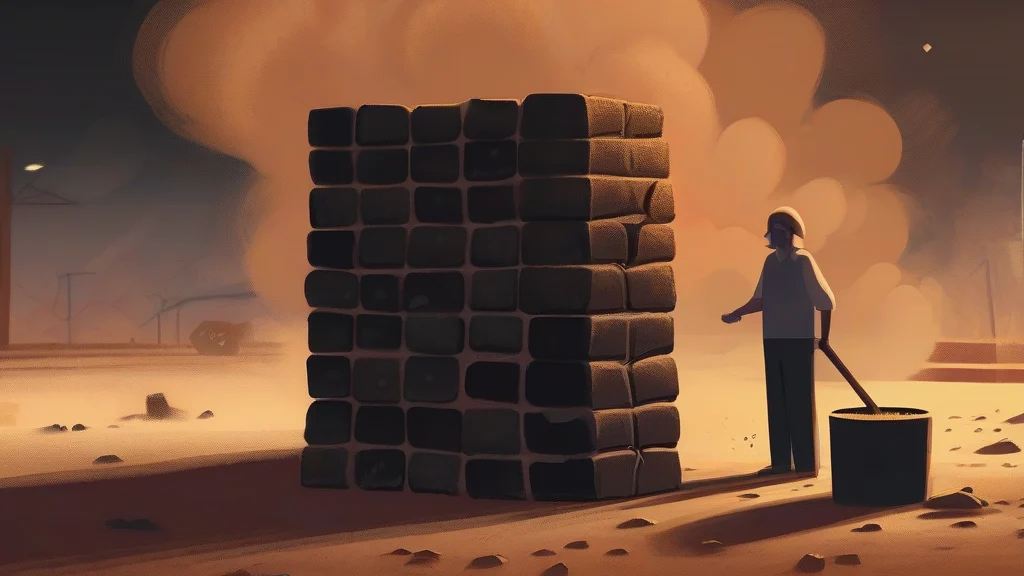
What does briquette mean?
A briquette is a small block of compressed combustible material, most commonly charcoal, coal dust, sawdust, or biomass, formed under pressure into a uniform shape for burning as fuel. The word entered English from French, where it is a diminutive of 'brique,' meaning brick — a fitting name, since briquettes are essentially little bricks of fuel. In everyday speech the plural form dominates: backyard cooks speak almost reflexively of 'charcoal briquettes' when firing up the grill, while industrial and energy contexts use the term for manufactured fuel blocks made from compressed waste materials such as sawdust or agricultural residue. Because briquettes burn evenly and are easy to store and transport, they became the standard fuel format for barbecues and remain important in household heating and small-scale industry worldwide. The word carries no strong connotation — it is neutral, practical vocabulary — but its French pedigree gives it a slightly formal air compared with plainer alternatives like 'fuel block' or 'coal brick.' Knowing it helps in cooking, camping, and energy-related reading alike.
nounA small block of compressed material — typically coal dust, charcoal, sawdust, or other combustible matter — used as fuel.
- A small block of compressed fuel made from coal dust, charcoal, sawdust, or similar combustible material.
"She stacked a fresh bag of charcoal briquettes beside the grill before lighting the fire."
"The campers fed another briquette into the stove to keep the coffee hot through the night."
"Modern briquette plants compress industrial waste wood into clean-burning blocks for domestic heating."
The standard plural simply adds -es to the base word. The plural form is by far the more frequent in real-world use, especially in grilling contexts.
"A twenty-pound bag of briquettes will last an entire summer of weekend cookouts."
The word 'briquette' is literally a French diminutive of 'brique' — so every barbecue in America is fueled by 'little bricks.'
Reviewed by Deb Chak, Editor. AI-assisted content curated by RJS Tech Solutions LLP.
Etymology of briquette
Briquette comes from the French word 'briquette,' a diminutive of 'brique,' meaning brick, which itself likely derives from Middle Dutch 'bricke.' English borrowed the term in the late nineteenth century as compressed-fuel manufacturing spread from continental Europe. It shares its ultimate root with the English word 'brick,' making them true cognates across languages.
Related word forms
How briquette is actually used
Most often encountered in the plural ('briquettes'), especially in the fixed phrase 'charcoal briquettes' for grilling. The singular is more common in technical or industrial contexts. Spelled 'briquette' in both British and US English, though 'briquet' appears occasionally in older or trade usage.
Easily confused with briquette
A bracket is a support or punctuation mark, while a briquette is a compressed block of fuel; they share distant French roots but nothing else.
A biscuit is a baked food, whereas a briquette is a block of compressed fuel material.