
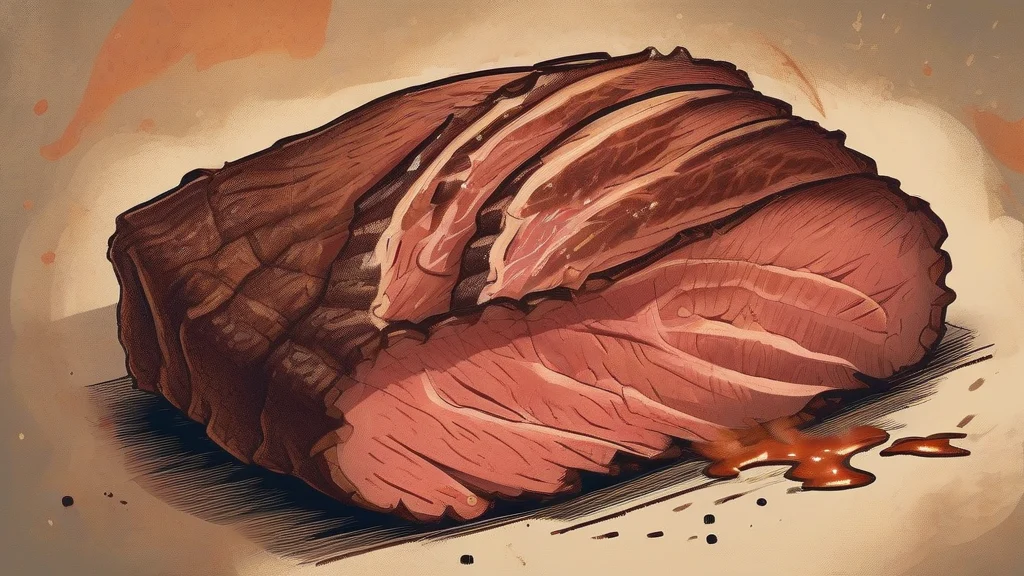
What does brisket mean?
Brisket is a noun referring to the cut of meat taken from the breast or lower chest of an animal, most commonly beef. Because this muscle supports much of the animal's weight and sees constant use, it is dense with connective tissue and naturally tough, which makes brisket unsuited to quick cooking. Instead, it rewards long, slow methods — braising, pot-roasting, or smoking over low heat for many hours — that break down its collagen into rich, yielding tenderness. The word appears constantly in culinary writing and menus, especially in the contexts of Texas barbecue, Jewish deli cooking (as corned beef or pastrami), and traditional British roasts. Beyond the kitchen, brisket has a minor anatomical sense denoting the chest region itself, though this is largely confined to veterinary or technical usage. Warmly associated with home cooking, patience, and communal meals, the word evokes both craft and comfort.
nounA cut of beef taken from the breast or lower chest of the animal, typically sold boneless and cooked slowly by braising, smoking, or roasting.
- The meat from an animal's breast or lower chest region, especially beef.
- In anatomy, the breast or chest of an animal (a more technical or veterinary sense).
"The pitmaster smoked the brisket for twelve hours until it was tender enough to pull apart with a fork."
"She slow-braised the brisket overnight so it would be fork-tender by morning."
"The butcher pointed out where the brisket sits along the cow's lower rib cage."
The plural is regular but uncommon in everyday speech, as brisket is usually treated as an uncountable mass noun when referring to the meat. The plural appears mostly in commercial or butchery contexts referring to multiple cuts.
"The smokehouse goes through dozens of briskets every weekend."
Brisket comes from a muscle that does all the work holding up half a cow's weight — which is exactly why it needs twelve hours of smoke to become tender.
Reviewed by Deb Chak, Editor. AI-assisted content curated by RJS Tech Solutions LLP.
Etymology of brisket
Brisket entered English in the mid-17th century, borrowed either from Old French 'bruschet' or directly from Middle English forms, ultimately tracing back to the Old Norse word 'brjósk', meaning cartilage or gristle. This Norse root also gave English the adjective 'brisk' through related development, making them distant cousins. The word has remained remarkably stable in meaning since its adoption, always denoting the chest region and, by extension, the meat cut from it.
How brisket is actually used
Brisket is primarily a culinary and butchery term; in everyday speech it almost always refers to beef. It carries warm, homely connotations associated with comfort food and traditional family cooking — Jewish, Texan barbecue, and British pot-roast traditions all prize it. The word is informal-to-neutral in register and rarely used outside food contexts.
Easily confused with brisket
A basket is a woven container, while brisket is a cut of meat from a cow's chest — they differ only by one letter but are entirely unrelated.