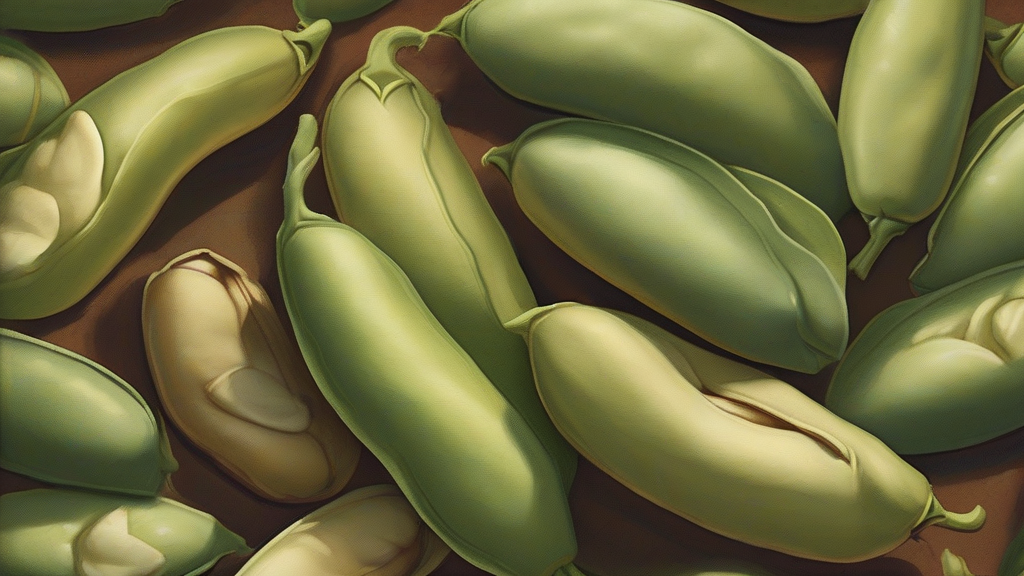
What does broadbean mean?
The broadbean, usually written as two words as 'broad bean', is the large flat seed of Vicia faba, an upright annual legume that has been cultivated since antiquity and remains a staple vegetable in many parts of Europe, the Middle East, and Asia. The term refers both to the plant itself and to its edible seeds, which are commonly shelled and cooked fresh in spring dishes such as stews, purees, and salads, or dried and stored for later use. In British English 'broad bean' is the everyday name, whereas American speakers typically call the same crop the 'fava bean'. Beyond the kitchen, broadbeans are valued agriculturally: as legumes, they fix nitrogen in the soil and are widely used in crop rotation. Related names such as 'horse bean' and 'field bean' refer to varieties grown chiefly for animal feed. The word is informal-to-neutral in register and appears most often in cooking, gardening, and farming contexts.
nounA broadbean (usually written 'broad bean') is an upright annual legume, Vicia faba, cultivated for its large flat edible seeds, which are eaten fresh or dried. The term also refers to the seed itself.
- The plant Vicia faba, an Old World legume bearing large pods with big flat seeds.
- One of the large flat edible seeds of this plant, eaten fresh or dried.
"She shelled a bowl of fresh broadbeans for the spring salad."
"Broadbeans braised with garlic and mint are a classic spring dish across the Mediterranean."
"Farmers rotated their fields with broadbeans to restore nitrogen to the soil."
Regular plural; when written as two words, the noun 'bean' takes the plural ('broad beans').
"We bought two pounds of fresh broadbeans at the market."
The broadbean is one of humanity's oldest cultivated crops, grown in the Mediterranean for thousands of years — and legend has it Pythagoras told his followers to avoid eating beans altogether.
Reviewed by Deb Chak, Editor. AI-assisted content curated by RJS Tech Solutions LLP.
Etymology of broadbean
The compound combines 'broad', from Old English 'brād' meaning wide, with 'bean', from Old English 'bēan', which descends from a common Germanic root reflected in Dutch 'boon' and German 'Bohne'. Beans were among the earliest crops brought to Britain, so the word has been part of English since its earliest recorded stages. The specific term 'broad bean' arose to distinguish Vicia faba's large flat seeds from other kinds of beans encountered later, and it coexists with the borrowed Italian-derived name 'fava bean', now standard in American English.
How broadbean is actually used
The word is normally written as two words, 'broad bean'; the solid form 'broadbean' is less common. 'Broad bean' is the standard British term, while American English more often uses 'fava bean'. The compound takes a regular plural ('broad beans'), and both the plant and its seed are referred to by the same word.
Easily confused with broadbean
A green bean is the immature pod of the common bean (Phaseolus vulgaris) eaten whole, whereas a broadbean is the large flat seed of Vicia faba, typically shelled before eating.