What does broccoli mean?
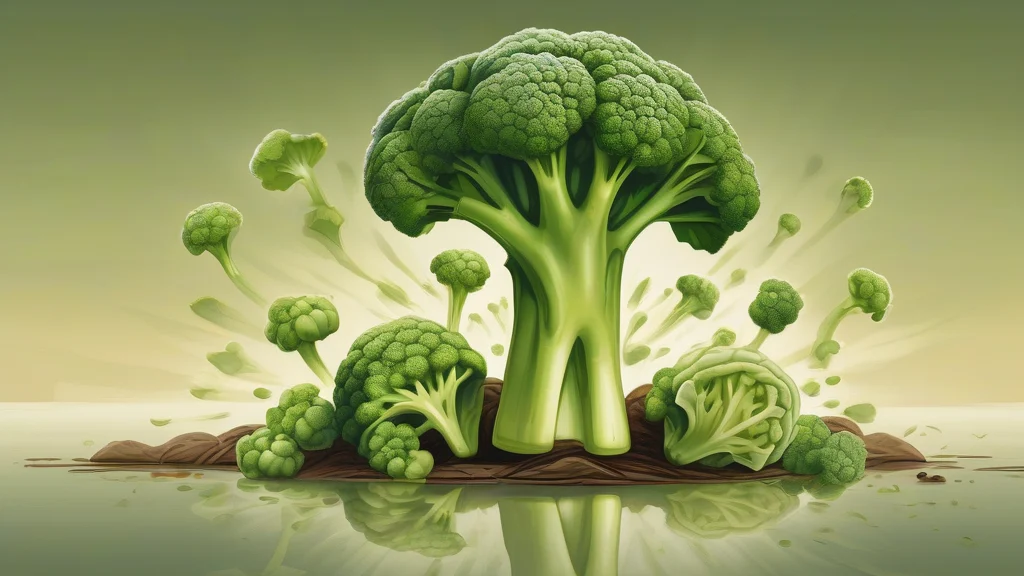
Broccoli is a green vegetable belonging to the cabbage family, grown for its compact head of tender flower buds and its thick, edible stalks. A cool-season cultivar of Brassica oleracea — the same species that gives us cabbage, cauliflower, and kale — it is prized for being nutrient-dense, providing fiber, vitamin C, and vitamin K. In the kitchen it is remarkably versatile: it can be steamed, roasted, stir-fried, blanched, or eaten raw with dip, though overcooking turns it mushy and dulls its color. The word entered English from Italian in the seventeenth century, but the vegetable itself only became widely popular in Britain and America during the twentieth century, largely through Italian immigrant communities. Today it stands as one of the most recognizable symbols of healthy eating, so much so that 'eat your broccoli' has become shorthand for doing something wholesome you might not enjoy.
nounA green vegetable of the cabbage family (Brassica oleracea var. italica), eaten for its dense cluster of immature flower buds on thick edible stalks; also the plant itself.
- The vegetable: the compact head of green flower buds and thick stalks of Brassica oleracea var. italica, eaten cooked or raw.
- The plant itself, cultivated as a cool-season crop.
"She steamed the broccoli just long enough to keep its bright green color and crisp bite."
"Add the broccoli to the stir-fry in the last two minutes so it stays crisp."
"Their garden produced an unusually large head of broccoli despite the cold spring."
'Broccoli' is normally a mass noun — say 'some broccoli' rather than 'a broccoli'. When distinct heads must be counted, speakers prefer 'heads of broccoli'; the inflected plural 'broccolis' is uncommon and informal.
"The market had three fresh broccolis on display, though most shoppers would simply ask for three heads of broccoli."
Broccoli was engineered by Italian farmers from wild cabbage centuries before 'superfood' existed — and Americans barely ate it until the 1920s, when Italian immigrants made it mainstream.
Reviewed by Deb Chak, Editor. AI-assisted content curated by RJS Tech Solutions LLP.
Etymology of broccoli
Broccoli comes from the Italian plural of broccolo, meaning 'cabbage sprout,' a diminutive of brocco, meaning 'shoot' or 'sprout.' The Italian brocco ultimately traces back to Latin broccus, meaning 'projecting' or 'pointed.' The word entered English in the early seventeenth century, though the vegetable did not become widely eaten in the English-speaking world until much later. It shares this Latin root with brocade, whose Italian source broccato also derives from brocco.
How broccoli is actually used
In English 'broccoli' functions as a mass noun ('some broccoli', not 'a broccoli'), though it can be countable when referring to individual heads ('two broccolis' is rare and informal). In British English the term 'calabrese' is sometimes used specifically for the common green heading type, reserving 'broccoli' for sprouting varieties. There are no significant connotation issues; the word carries neutral, everyday register.
Easily confused with broccoli
Broccolini is a hybrid of broccoli and Chinese broccoli with long thin stalks and small florets, whereas ordinary broccoli has a large dense flowering head on thick stalks.
Cauliflower is a closely related cultivar with a typically white curd, while broccoli's flowering head is green.