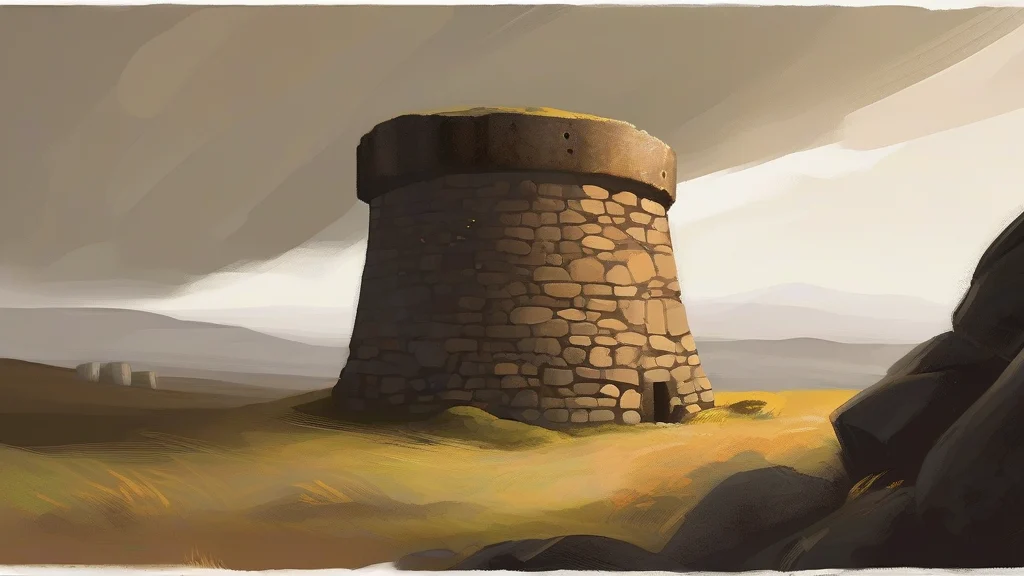
What does broch mean?
A broch is a distinctive round stone tower built during the Scottish Iron Age, found mainly in the north and west of Scotland, especially Orkney, Shetland, Caithness, and the Western Isles. Brochs were constructed entirely of dry-stone masonry — no mortar was used — with characteristic double walls between which ran galleries and staircases, giving access to internal chambers. They could reach considerable heights, and the best-preserved example, Mousa Broch on Shetland, still stands to around thirteen metres. Archaeologists debate their exact purpose, with theories ranging from fortified dwellings to symbols of status for local elites. More than five hundred broch sites have been identified, making them one of the most striking monuments of prehistoric Britain. The word itself comes through Scots, ultimately of Scandinavian origin, reflecting the Norse influence on northern Scotland. Today, 'broch' appears mostly in archaeology, heritage tourism, and place-names, and it carries strong connotations of Scotland's ancient past.
nounA broch is an Iron Age dry-stone round tower found in northern and western Scotland, typically double-walled with a hollow interior and accessible chambers within the walls.
- An Iron Age drystone round tower of northern and western Scotland, built with double walls containing galleries and stairways.
"The ruins of Mousa Broch on Shetland still stand nearly intact after two thousand years."
"Archaeologists have surveyed the remains of over five hundred brochs across the Highlands and Islands."
"Visitors can climb the spiral staircase inside Mousa Broch, the finest surviving example in Scotland."
Standard regular plural; used freely in archaeological literature.
"The region contains dozens of brochs dating from the first millennium BC."
Scotland's brochs are hollow towers built without any mortar — some, like Mousa Broch on Shetland, are still standing after more than 2,000 years.
Reviewed by Deb Chak, Editor. AI-assisted content curated by RJS Tech Solutions LLP.
Etymology of broch
The word 'broch' entered English through Scots, where it has long been applied to these ancient towers. Its ultimate origin is usually traced to Old Norse 'borg', meaning a fortification or stronghold, which reflects the Scandinavian settlement of northern Scotland. It is thus related to the Germanic root that also gives us 'burgh' and 'borough'.
How broch is actually used
The word is chiefly used in British English, particularly in archaeological writing and in discussions of Scottish heritage. The final consonant is often pronounced as a guttural 'ch' as in 'loch', though an anglicised 'k' sound is common outside Scotland.
Easily confused with broch
Brough is a place-name for several English villages, while a broch is a prehistoric stone tower in Scotland.