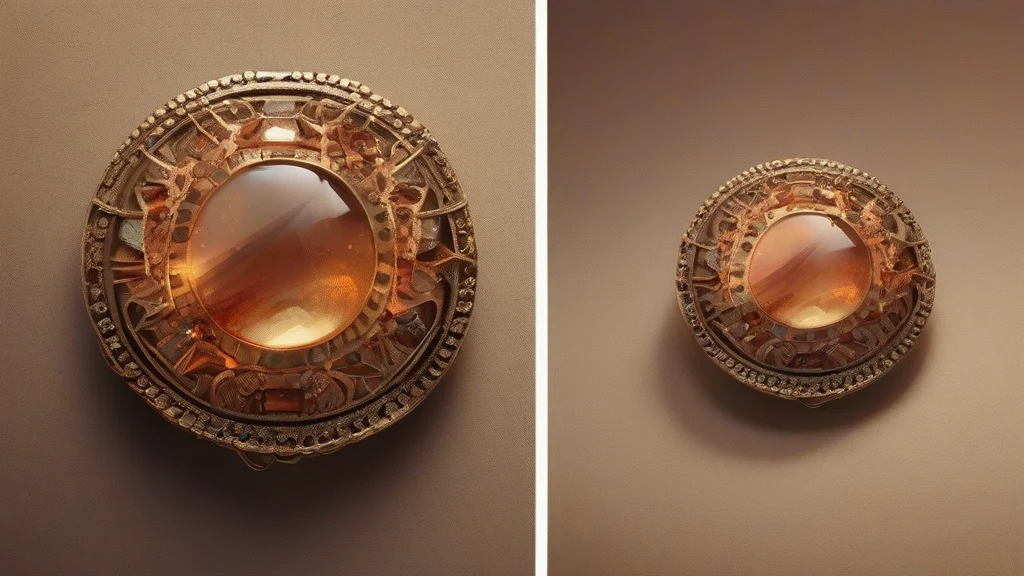
What does broche mean?
"Broche" is a noun denoting an ornamental pin or clasp worn on clothing — essentially what modern English spells "brooch." The spelling survives chiefly in historical texts, in French usage, and in the related textile term "broché," which describes fabric woven with a raised, embroidered-looking pattern. The word entered English from Old French "broche," meaning a skewer or pointed instrument, from Late Latin "brocca." Because the original sense involved piercing, the same root also produced the English verb "to broach," first meaning to pierce a cask and later to introduce a topic for discussion. Today, encountering "broche" usually signals either an antique text or a French influence; everyday writing calls for the standard spelling "brooch." Its synonyms include pin, clasp, and pendant, depending on the object's design and function.
nounA decorative ornament, typically a jeweled or metal pin, worn fastened to clothing; an archaic or French-derived spelling of what modern English writes as "brooch." In textile terminology, the related form "broché" describes fabric woven with an embroidered-looking pattern.
- An ornamental pin or clasp worn on clothing; a brooch (now rare or archaic in this spelling)
"She pinned the antique silver broche at her collar before stepping out into the evening."
"The duchess wore a diamond-studded broche fastened to her sash."
"Among the heirlooms was a Victorian broche passed down through four generations."
Because the spelling "broche" is rare in modern English, its plural is seldom encountered; the plural of the standard form is "brooches."
"The collection displayed dozens of enamel broches from the eighteenth century."
That elegant pin on your lapel once went by "broche" — the same word that gave English both "brooch" and the verb "to broach," because early pins literally pierced the fabric.
Reviewed by Deb Chak, Editor. AI-assisted content curated by RJS Tech Solutions LLP.
Etymology of broche
"Broche" comes from Old French "broche," meaning a skewer, spit, or pointed tool, which derives from Late Latin "brocca" (a pointed object), itself possibly from a Gaulish source. When the word was adopted into Middle English, it came to mean a pin or clasp that pierced fabric — hence the jewelry sense. The same Latin root gave English both "brooch" (the standard modern spelling) and the verb "broach" (originally to pierce a cask), making them doublets of one another. The adjectival form "broché" later developed in French textile vocabulary to describe fabric with a woven, needlework-like pattern.
How broche is actually used
In contemporary English, "brooch" is the standard spelling; "broche" survives mainly as a historical variant, in French contexts, or in the textile term "broché" (fabric with a woven-in design). Writers today should use "brooch" unless quoting older texts.
Easily confused with broche
"Brooch" is the standard modern English spelling for the ornamental pin, while "broche" is an archaic or French spelling of the same object.
"Broach" is most commonly a verb meaning to raise a subject for discussion or to pierce a container, whereas "broche" refers to a piece of jewelry.
"Broché" is an adjective describing fabric with a woven, embroidered-style pattern, not a piece of jewelry.