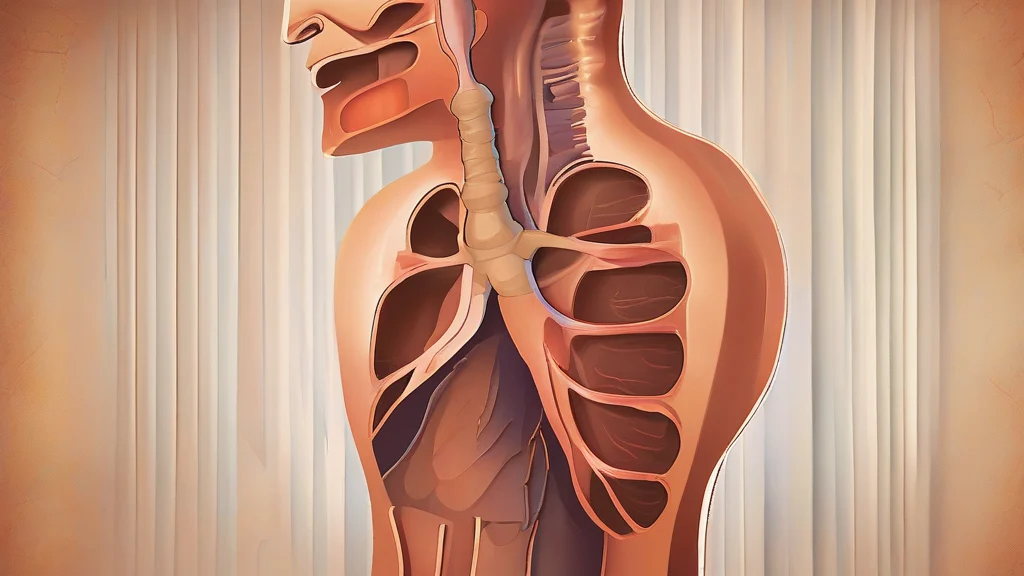
What does bronchiectasis mean?
Bronchiectasis is a chronic respiratory condition in which the bronchi — the branching airways that carry air into the lungs — become permanently widened and scarred. This structural damage impairs the normal clearing of mucus, allowing secretions to pool and bacteria to flourish, which leads to a cycle of chronic coughing, copious sputum production, and repeated chest infections. The condition may follow childhood infections such as pneumonia or measles, or arise from underlying diseases including cystic fibrosis and primary ciliary dyskinesia; sometimes no cause is identified. Diagnosed by CT scanning, it is managed rather than cured, using airway clearance techniques, antibiotics, and treatment of flare-ups. The word derives from Greek roots meaning 'windpipe' and 'stretching out', and the related adjective 'bronchiectatic' appears frequently in medical writing.
nounA chronic medical condition in which the walls of the bronchi (the airways leading to the lungs) are permanently widened and damaged, impairing mucus clearance and causing recurrent infection and cough.
- A chronic lung condition marked by permanent, abnormal dilation of the bronchial airways, typically causing chronic cough, excess sputum, and recurrent respiratory infections.
"Her persistent cough was eventually traced to bronchiectasis rather than simple asthma."
"Cystic fibrosis is one of the most common underlying causes of bronchiectasis in younger patients."
"After years of recurrent pneumonia, scans confirmed she had developed bronchiectasis in both lower lobes."
The word comes from Greek for 'windpipe' plus 'stretching out' — literally 'a stretching of the bronchi', a name coined in the 19th century when doctors could finally see the damage in autopsies.
Reviewed by Deb Chak, Editor. AI-assisted content curated by RJS Tech Solutions LLP.
Etymology of bronchiectasis
Bronchiectasis comes from New Latin, formed from the Greek-derived elements 'bronchia' (the bronchi, ultimately from Greek 'bronkhos', meaning windpipe or throat) and 'ekstasis', meaning extension or dilation (from 'ek', out, and 'stasis', a standing). The compound was coined in nineteenth-century medical Latin to describe the stretched, dilated airways observed pathologically. It shares its roots with terms such as 'bronchitis', 'bronchus', and 'atelectasis', all built on these classical elements.
Related word forms
How bronchiectasis is actually used
A technical term used mainly in medicine; it is an uncountable mass noun in ordinary clinical usage, though the adjective form 'bronchiectatic' is common in radiology and pathology reports.
Easily confused with bronchiectasis
Bronchitis is inflammation of the airways that is often temporary, whereas bronchiectasis is a permanent, structural widening of the airways.
Atelectasis is the collapse of part of a lung, while bronchiectasis is abnormal permanent widening of the airways.