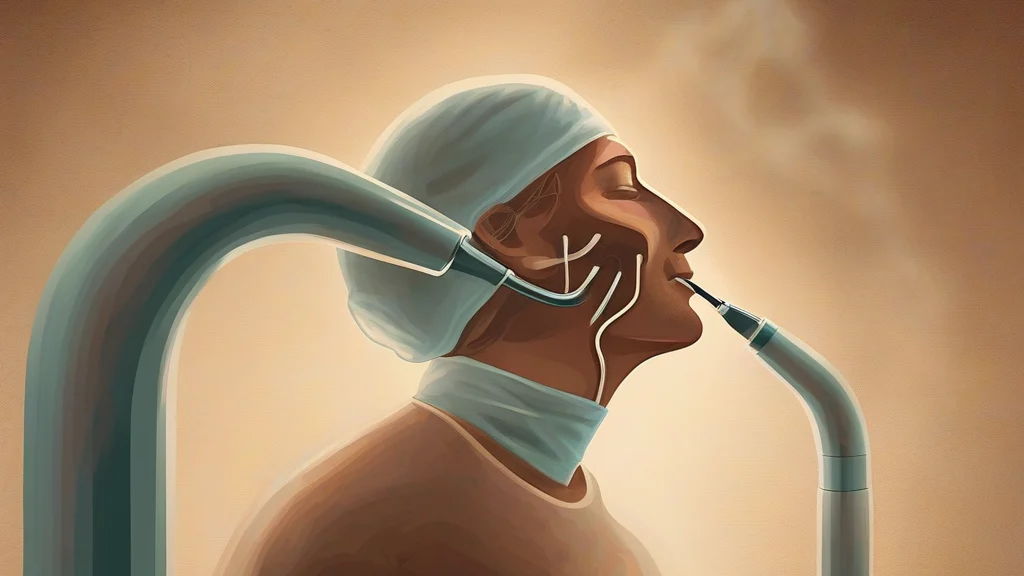
What does bronchoscopy mean?
Bronchoscopy is a medical procedure used to examine the inside of the airways — the trachea and the branching network of bronchial tubes that lead into the lungs. A doctor passes a bronchoscope, a slender tube equipped with a light and camera, through the nose or mouth and down the throat, producing live images of the airway lining. The technique serves both diagnostic and therapeutic purposes: it can reveal tumours, inflammation, infection, or bleeding; allow tiny forceps to take tissue biopsies; wash out cells for laboratory analysis; retrieve inhaled objects; and deliver targeted treatments. Bronchoscopy may be flexible, using a bendable scope under local anaesthesia and mild sedation, or rigid, using a straight metal instrument under general anaesthesia for more complex work. It is a cornerstone of modern respiratory medicine, valued as a minimally invasive alternative to exploratory surgery. The word derives from Greek roots meaning windpipe and observation, and belongs to the family of '-scopy' procedures such as endoscopy and colonoscopy.
nounA medical procedure in which a bronchoscope (a thin, flexible or rigid tube with a light and camera) is passed through the nose or mouth into the airways to examine the trachea, bronchi, and lungs, allowing direct visual inspection, tissue sampling, and certain treatments.
- A diagnostic or therapeutic medical procedure in which a bronchoscope is inserted through the nose or mouth into the trachea and bronchi to visually inspect the airways, collect tissue or fluid samples, remove foreign bodies, or perform interventions.
"The pulmonologist performed a bronchoscopy to obtain a biopsy of the suspicious lesion."
"After weeks of a persistent cough that wouldn't respond to antibiotics, her physician recommended a bronchoscopy to rule out anything more serious."
"Flexible bronchoscopy, performed under local anaesthesia, allows doctors to inspect the bronchial tree and take small tissue samples without open surgery."
The plural is used when referring to multiple separate procedures, typically in clinical statistics or research contexts.
"Over 500,000 bronchoscopies are performed annually in the United States."
The word 'bronchoscopy' literally means 'looking into the windpipe's branches' — because your airways really do branch like a tree, and doctors call it the bronchial tree.
Reviewed by Deb Chak, Editor. AI-assisted content curated by RJS Tech Solutions LLP.
Etymology of bronchoscopy
Bronchoscopy comes from two Greek roots: 'bronchos', referring to the windpipe or its branches, and '-skopein', meaning to look or examine. The procedure itself dates to the late nineteenth century, when German physician Gustav Killian performed pioneering rigid examinations of the airways in the 1890s, earning him recognition as the father of bronchoscopy. The term follows the same Greek-derived pattern as other endoscopic procedures such as gastroscopy and colonoscopy, all built on the combining form '-scopy'. Related words sharing the bronch- root include bronchus, bronchitis, and bronchiole.
Related word forms
How bronchoscopy is actually used
Bronchoscopy is a formal clinical term used almost exclusively in medical contexts. It refers to the procedure itself rather than the instrument (the bronchoscope). It may be described as flexible (using a soft fibreoptic or video scope) or rigid (using a straight metal tube, typically under general anaesthesia), depending on the purpose.
Easily confused with bronchoscopy
Bronchitis is inflammation of the bronchial tubes, whereas bronchoscopy is an examination procedure used to view those airways.
Gastroscopy examines the stomach and upper digestive tract using an endoscope, while bronchoscopy specifically examines the airways and lungs.