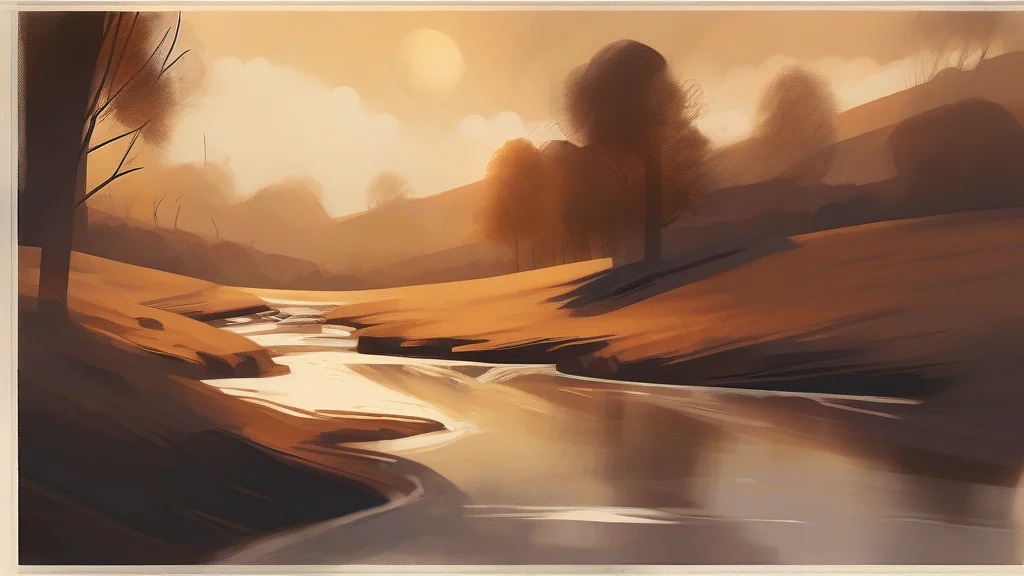
What does brooklet mean?
A brooklet is a very small brook — a slender, often shallow stream of flowing water, typically found in hillsides, woodlands, and meadows. The word is formed by adding the diminutive suffix "-let" to "brook," explicitly signaling that the stream in question is smaller than a brook proper. Though perfectly well established in English, "brookelet" belongs mainly to literary and descriptive registers: it appears frequently in poetry, nature writing, and nineteenth-century prose, where writers prized it for its soft sound and evocative charm. It conjures images of water murmuring over stones, threading through moss and fern, and glinting in dappled woodland light. In modern conversation most speakers simply say "stream" or "little brook," so encountering "brookelet" usually signals deliberate, picturesque style. For readers and writers alike, it remains a precise and graceful term when an ordinary word for a small stream feels too plain.
nounA small brook; a tiny stream of running water.
- A very small brook or stream of running water.
"A clear brooklet trickled down through the ferns at the bottom of the valley."
"The path crossed and recrossed a cold brooklet fed by snowmelt."
"In the fading light, the brooklet murmured over its bed of smooth pebbles."
Standard regular plural; used mainly in descriptive or poetic prose.
"Countless brookelets stitched the mountainside with silver threads."
English never met a stream it couldn't shrink — brook became brooklet with the same affectionate '-let' that turned 'book' into 'booklet.'
Reviewed by Deb Chak, Editor. AI-assisted content curated by RJS Tech Solutions LLP.
Etymology of brooklet
Brookelet combines "brook," from Old English "brōc" meaning a stream, with the diminutive suffix "-let," borrowed from French and used productively in English from the Middle English period onward to form miniature nouns such as "booklet" and "ringlet." The compound arose as a natural literary formation rather than a borrowing, appearing in English writing as a poetic diminutive for a small stream. Its closest relative is simply its base, "brook," which has Germanic origins and survives across the Germanic language family in related water-and-marsh terms.
How brooklet is actually used
"Brooklet" is chiefly literary and somewhat archaic in flavor, appearing mostly in descriptive prose and poetry rather than everyday speech. It carries gentle, idyllic connotations of countryside and pastoral scenery. In ordinary conversation, speakers are more likely to say "stream" or "little brook."
Easily confused with brooklet
A brook is any small stream, while a brooklet is specifically a very small or diminutive one.