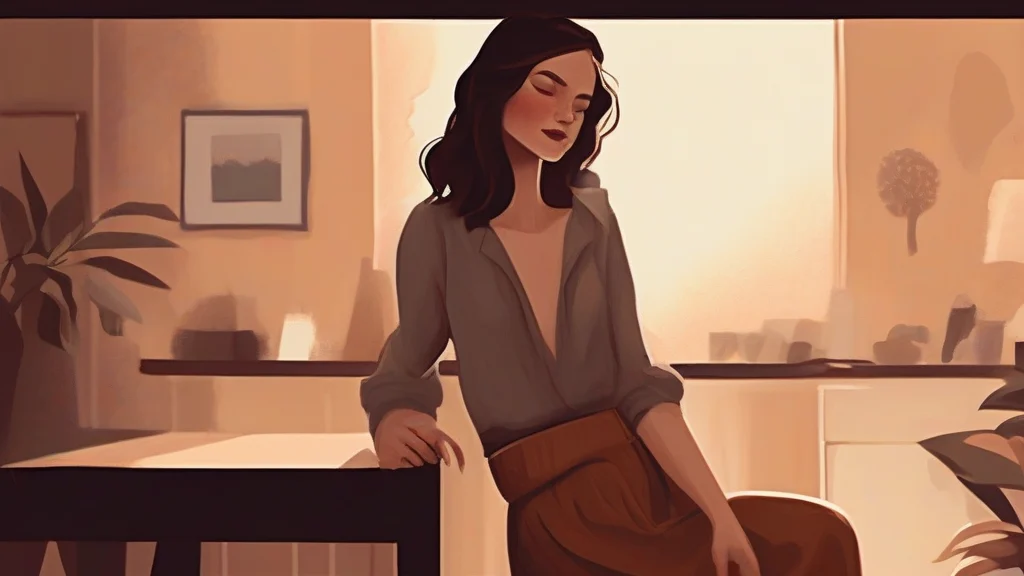
What does brunette mean?
A brunette is a person — most commonly a woman or girl — whose hair is dark brown. The word functions as both a noun ('she is a brunette') and, less commonly, as an adjective describing hair colour ('a brunette actress'). It entered English in the seventeenth century from French, where 'brunette' is the feminine form of 'brunet', a diminutive of 'brun', meaning brown. In modern English usage, 'brunette' has largely absorbed the role of the older masculine 'brunet', though careful writers may still distinguish them. The term is neutral in register and appears frequently in descriptions of appearance, in fiction, and in popular culture, where hair colour is often treated as a shorthand for character type — for instance, contrasting blondes, redheads, and brunettes. Its enduring usefulness lies in its precision: unlike simply saying someone has 'brown' hair, calling someone a brunette identifies a specific, widely recognised colouring.
A person, especially a woman or girl, with dark brown hair.
"The artist painted the portrait of a young brunette gazing out of the window."
Historically restricted to females; the older masculine form is 'brunet'.
(Of hair or a person) Having dark brown hair.
"She chose a brunette wig for the costume party."
Standard plural; applies only when 'brunette' is used as a noun.
"The agency was recruiting brunettes for the winter campaign."
In French, adding the feminine '-ette' to 'brun' didn't just make it female — it made the word itself smaller, since '-ette' is a diminutive meaning 'little brown'.
Reviewed by Deb Chak, Editor. AI-assisted content curated by RJS Tech Solutions LLP.
Etymology of brunette
Brunette comes from the French 'brunette', the feminine form of 'brunet', itself a diminutive of 'brun', meaning brown. The French word 'brun' ultimately derives from a Germanic root related to brightness and shining, which also gave English the word 'brown'. English borrowed the term in the seventeenth century, initially using 'brunet' for men and 'brunette' for women, before 'brunette' became the general term for anyone with dark brown hair.
Related word forms
How brunette is actually used
Traditionally applied mainly to women; when used of men, some writers prefer the form 'brunet'. As an adjective ('a brunette model') it is fully standard. The word carries no strong connotation of formality and is neutral in register.
Easily confused with brunette
'Brunet' is the older masculine form of the same word and can refer to anyone with dark brown hair, whereas 'brunette' is now the common term and is used especially for women.
Despite the similar '-ette' ending pattern in some words, 'blackhead' refers to a clogged skin pore, not a hair colour or hair type.