
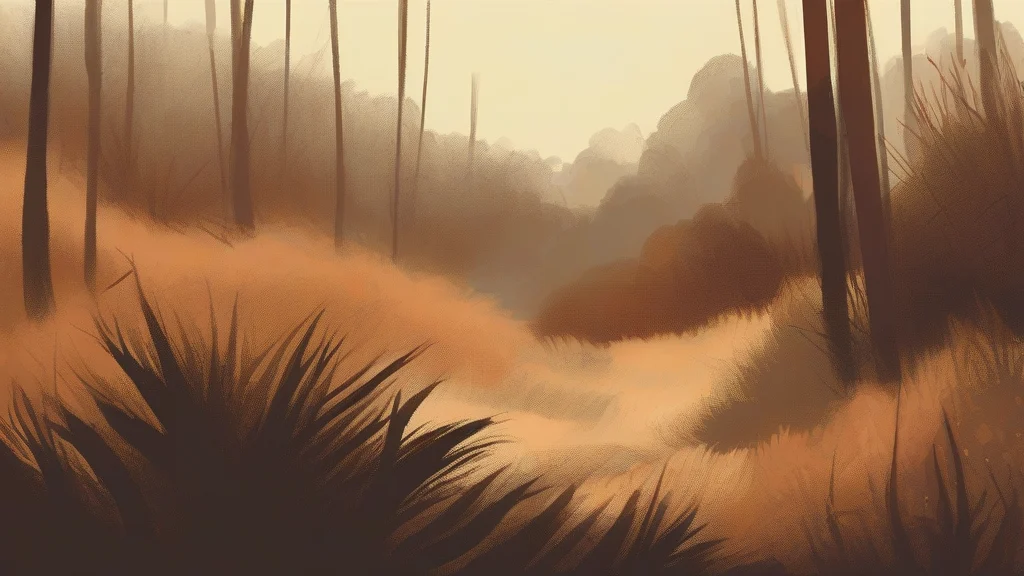
What does brushy mean?
Brushy is an adjective describing land or vegetation that is densely covered with brush — the tangle of shrubs, bushes, saplings, and small trees that springs up in uncultivated areas. A brushy hillside, a brushy ravine, or a brushy field edge is one where woody growth has taken hold, often making travel difficult and providing cover for wildlife such as rabbits, quail, and deer. Beyond its literal landscape sense, the word can describe anything thick or shaggy in a manner suggestive of a brush, though this extended use is less common. Brushy appears frequently in contexts of hiking, hunting, wildlife biology, and wildfire management, since dense brush serves both as valuable animal habitat and as hazardous fuel for fires. Its synonyms include overgrown, bushy, shrubby, and thick, while its natural opposites are bare, clear, or open terrain. The term is informal-to-neutral in register and equally at home in everyday speech and technical land-management writing.
Covered with or abundant in brush — dense growth of shrubs, bushes, and small trees.
"The property's northern slope was too brushy to farm and was left to the rabbits and songbirds."
Resembling or having the texture of a brush; thick, shaggy, or bristly.
"He pushed back his brushy eyebrows and peered at the letter again."
This figurative sense is considerably less common than the landscape sense.
Firefighters fear brushy land for good reason — dense brush is exactly the kind of fuel that turns a spark into a wildfire.
Reviewed by Deb Chak, Editor. AI-assisted content curated by RJS Tech Solutions LLP.
Etymology of brushy
Brushy derives from brush, the English noun denoting a thicket of small trees and shrubs, combined with the adjectival suffix -y. The word brush itself entered English from Old French (broce or similar forms), with its ultimate origin uncertain but likely Romance in character. The adjective brushy arose by straightforward English derivation and shares its root with related compounds such as brushwood, underbrush, and brushfire.
How brushy is actually used
Primarily used in descriptions of landscape, habitat, and outdoor terrain; especially common in North American usage relating to hunting, hiking, and fire management. The word carries a neutral to slightly rugged connotation.
Easily confused with brushy
'Bushy' describes something thick and full like a bush (such as hair or eyebrows), while 'brushy' specifically refers to land or areas overgrown with brush and shrubs.