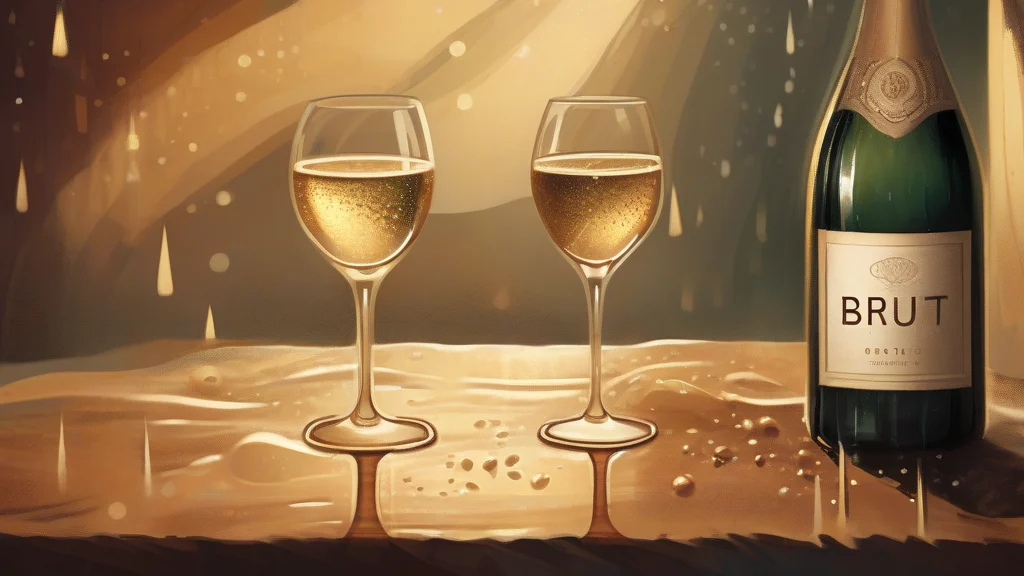
What does brut mean?
Brut is a term from French used to describe sparkling wine — most famously Champagne — that has been made in a very dry style, meaning only a small amount of residual sugar remains after fermentation. It sits near the driest end of the sweetness scale, drier than 'sec' or 'demi-sec' but slightly sweeter than 'extra brut' and 'brut nature', which contain virtually no added sugar. Because brut is by far the most popular style of Champagne produced today, the word appears constantly on labels, wine lists, and menus, making it one of the most useful vocabulary items for anyone navigating a restaurant or wine shop. The word literally means 'raw' or 'crude' in French, reflecting the idea that the wine's natural dryness is left largely unsoftened by sweetening. As well as functioning as an adjective ('a brut Champagne'), it can be used as a noun referring to the wine itself ('a glass of brut').
(Of sparkling wine) very dry, with little or no residual sugar.
"A chilled brut is the classic pairing for oysters."
A sparkling wine, especially Champagne, made in this very dry style.
"The bar offers three bruts by the glass."
The plural is usually rendered simply as 'brut' in wine-list contexts, though 'bruts' is acceptable in ordinary prose.
Used when referring to multiple bottles or styles of brut sparkling wine.
"We compared two bruts side by side at the tasting."
In the world of Champagne, 'brut' means the opposite of what it sounds like — it's the driest style on the menu, with less sugar than your morning coffee.
Reviewed by Deb Chak, Editor. AI-assisted content curated by RJS Tech Solutions LLP.
Etymology of brut
Brut comes directly from French brut, meaning 'raw', 'crude', or 'unrefined', which derives from Latin brutus of the same meaning. The word was adopted into English in the nineteenth century specifically as a wine term describing Champagne made with little residual sugar. It shares its Latin origin with English words such as brute, brutal, and brutish.
How brut is actually used
Almost exclusively used in wine contexts, especially for Champagne and other sparkling wines. 'Extra brut' denotes an even drier style than standard brut, while 'brut nature' (or 'zero dosage') indicates no added sugar at all.
Easily confused with brut
'Brute' means crude or animal-like (or a savage creature), while 'brut' is a wine term meaning very dry.