What does brutalism mean?
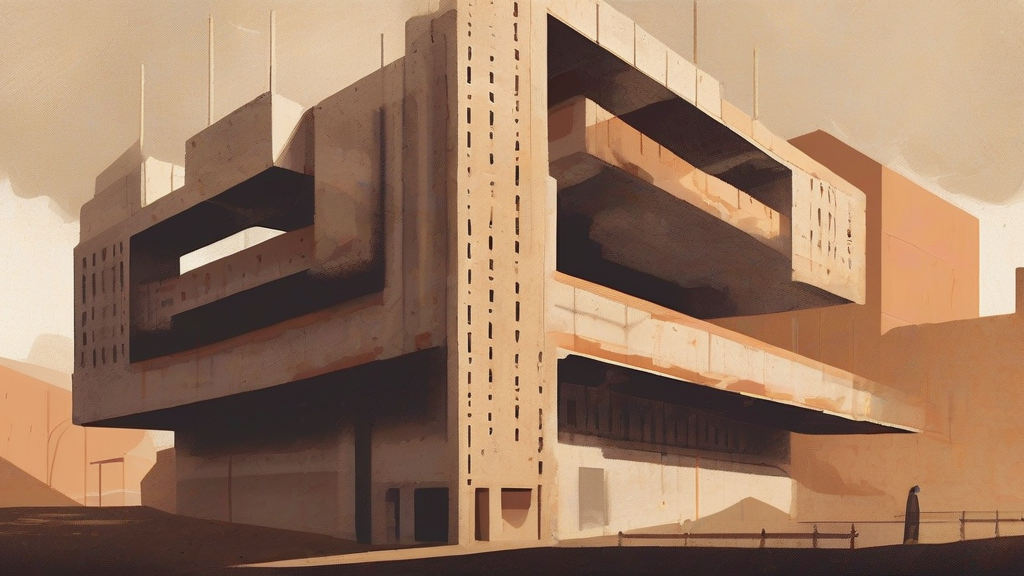
Brutalism is a noun denoting an influential architectural movement that flourished roughly from the 1950s to the mid-1970s, defined by massive, sculptural buildings made of raw concrete — known in French as béton brut, the phrase that gives the style its name. Brutalist structures favour exposed materials, repetitive modular shapes, and monumental scale, appearing in civic centres, universities, and housing estates across Europe, North America, and beyond. The word can also describe a deliberate roughness or unflinching directness in behaviour, art, or expression. Public feeling about architectural Brutalism has always been polarized: admirers praise its honesty, social ambition, and striking presence, while critics see grey, unwelcoming fortresses, and many significant buildings have been demolished even as others gain protected status. Whether used of concrete towers or blunt prose, brutalism conveys something severe, honest, and deliberately unadorned.
An austere style of architecture of the mid-20th century, characterized by massive, monolithic forms in raw concrete.
"The National Theatre in London is a landmark of postwar Brutalism."
Deliberate roughness, harshness, or absence of refinement in manner, style, or expression.
"He stated his objections with a brutalism that left no room for diplomacy."
Rarely pluralized; the plural appears mainly when distinguishing between different regional or national variants of the architectural style.
"Scholars have traced distinct national brutalisms across postwar Europe."
The name comes not from 'brutal' but from the French béton brut — raw concrete — yet the pun proved impossible to escape.
Reviewed by Deb Chak, Editor. AI-assisted content curated by RJS Tech Solutions LLP.
Etymology of brutalism
The term derives ultimately from the Latin brutus, meaning 'heavy, dull, irrational' (also the source of 'brute'), which passed into French as brut, 'raw or unrefined'. Its architectural sense was coined in Sweden — Hans Asplund described a house as 'ny-brutalism' around 1949–1950 — before being popularized in Britain by architects Alison and Peter Smithson and critic Reyner Banham in the early 1950s, drawing on Le Corbusier's French phrase béton brut for raw, unfinished concrete. Cognates include 'brutal', 'brutality', and 'brutish', all tracing back to the same Latin root.
Related word forms
How brutalism is actually used
When referring to architecture, the term is often capitalized ('Brutalism') by architectural historians, though lowercase use is common in general writing. In Britain especially, public opinion on Brutalist buildings is strongly divided: many were demolished in recent decades while others are now heritage-protected. The word carries connotations of both uncompromising honesty in design and cold, oppressive massiveness.
Easily confused with brutalism
'Brutality' means cruel violence, while 'brutalism' refers chiefly to an architectural style (or a general quality of harsh severity).