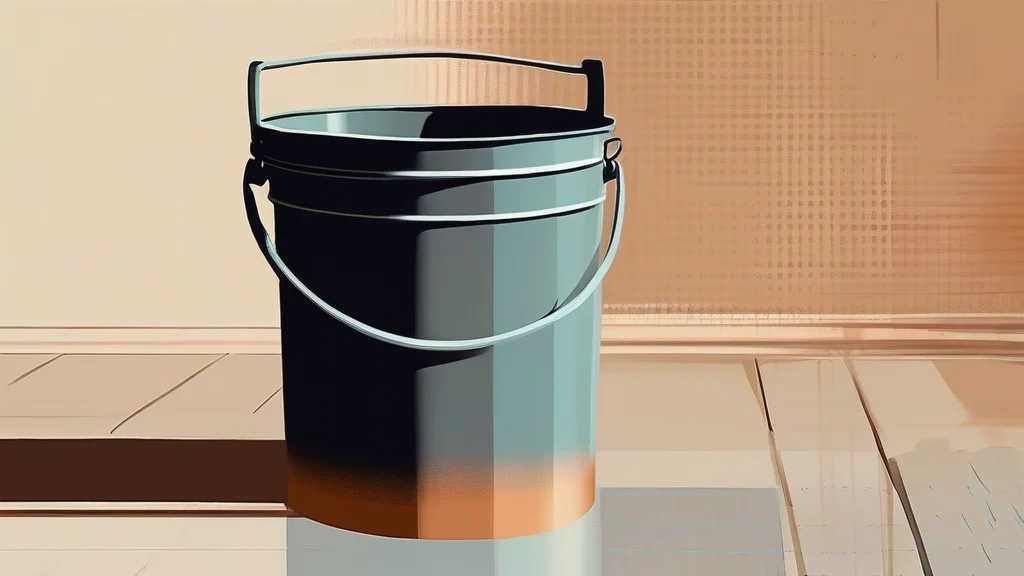
What does bucket mean?
A bucket is an everyday open-topped container, usually cylindrical, fitted with a handle and typically made of plastic, metal, or wood. Its most familiar purpose is carrying water, but buckets serve countless practical roles — holding sand, paint, ice, feed, or household waste — making the object one of the most universally recognised tools across cultures and eras. Beyond its literal sense, 'bucket' appears in several well-established idioms: a 'drop in the bucket' denotes something insignificantly small relative to what is needed, a 'bucket list' records experiences one hopes to have before dying, and 'kick the bucket' is a longstanding informal euphemism for dying itself. In informal speech the word can also denote abundance ('buckets of money') and, in British English, functions as a verb describing torrential rain. Simple, concrete, and endlessly useful, 'bucket' remains a staple of ordinary vocabulary on both sides of the Atlantic.
An open-topped container with a handle, typically cylindrical, used for carrying or holding liquids, sand, or other substances.
"The children built sandcastles with a spade and a bright red bucket."
Also used figuratively to mean a large quantity ('buckets of rain') and in fixed idioms such as 'kick the bucket'.
(British, informal) To rain heavily; also, to move quickly or recklessly, especially downhill or in a vehicle.
"It was absolutely bucketing down by the time we reached the campsite."
Standard plural, used both literally for multiple containers and figuratively for large quantities ('buckets of money').
"Two buckets were left out in the yard overnight."
The slang phrase 'kick the bucket' has been around since at least the 1700s, and its exact origin is still debated — possibly referring to a beam (a 'bucket') from which animals were hung at slaughter, or a person standing on one before hanging themselves.
Reviewed by Deb Chak, Editor. AI-assisted content curated by RJS Tech Solutions LLP.
Etymology of bucket
'Bucket' derives from Old English 'buc', meaning a belly or a vessel, and is related to similar words in other Germanic languages, such as German 'Bauch' meaning belly. The word entered general use in Middle English, where it came to denote specifically a container, and it has remained in continuous everyday use ever since. The diminutive suffix '-et' gives the modern form its shape, distinguishing it from the older root word.
Related word forms
How bucket is actually used
In British informal usage, 'bucket' can function as a verb ('to bucket down', meaning to rain heavily) and 'it's bucketing' describes very heavy rain. The word carries a homely, everyday register rather than a technical one.
Easily confused with bucket
A bouquet is a bunch of flowers, while a bucket is an open container for carrying things; they differ in both meaning and stress pattern.