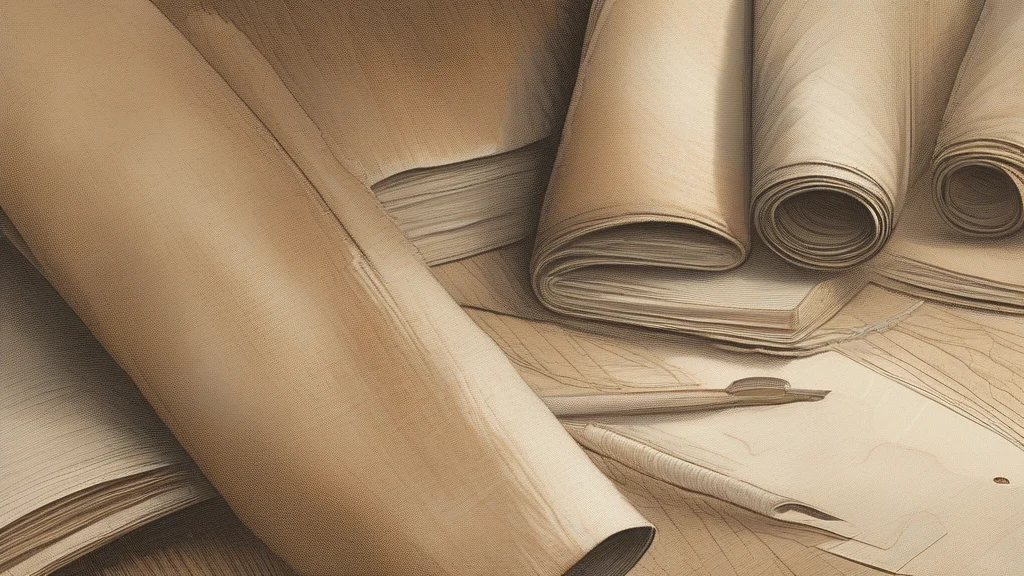
What does buckram mean?
Buckram is a stiff, coarse fabric made of cotton or linen that has been treated with gum, glue, or paste so it holds a firm shape. Its best-known use is in bookbinding, where durable 'library buckram' covers the boards of hardback books, protecting them through years of heavy handling; it is also employed in millinery and upholstery where structure matters more than softness. The word can function as a noun for the material itself and, less commonly today, as a figurative adjective describing something rigidly formal or pompous — a writer's style might be called 'stiff as buckram'. The term entered Middle English from Old French, ultimately deriving its name from Bukhara, the Central Asian trading city associated with the cloth's export along the Silk Road. Today buckram survives mostly as a specialist's term among binders, conservators, and craftspeople, though it retains a pleasing air of antiquity in general writing.
A coarse, stiff cotton or linen fabric treated with sizing, used especially in bookbinding and other applications requiring firmness.
"He covered the thesis boards in navy buckram before gluing down the endpapers."
In modern use, almost exclusively encountered in bookbinding, conservation, and costume/millinery contexts.
(Figurative) Stiff, formal, or unyielding, like the fabric; often applied to manner, style, or demeanor.
"Her buckram courtesy left no room for genuine conversation."
Literary and somewhat dated register.
Rare; used only when referring to different kinds or individual pieces of the fabric.
"The shop stocked several buckrams of differing weights and colours."
The word 'buckram' comes from Bukhara — the ancient Silk Road city in Central Asia that once exported the cloth to Europe.
Reviewed by Deb Chak, Editor. AI-assisted content curated by RJS Tech Solutions LLP.
Etymology of buckram
Buckram came into Middle English from Old French forms such as 'boquerant' or 'bougran', denoting a fine Oriental fabric. The name derives from Bukhara (in present-day Uzbekistan), a major trading city on the Silk Road through which such textiles reached Europe. Over time the English sense shifted from a costly imported cloth to the cheap, starched, utilitarian fabric known today, which became standard in bookbinding by the early modern period.
Related word forms
How buckram is actually used
Primarily a technical term in bookbinding and conservation; figurative use is literary and somewhat archaic. The plural is rare, referring to types or pieces of the cloth.
Easily confused with buckram
'Buckram' is a stiff fabric used in bookbinding, while 'bucolic' is an adjective describing rustic or pastoral life.