
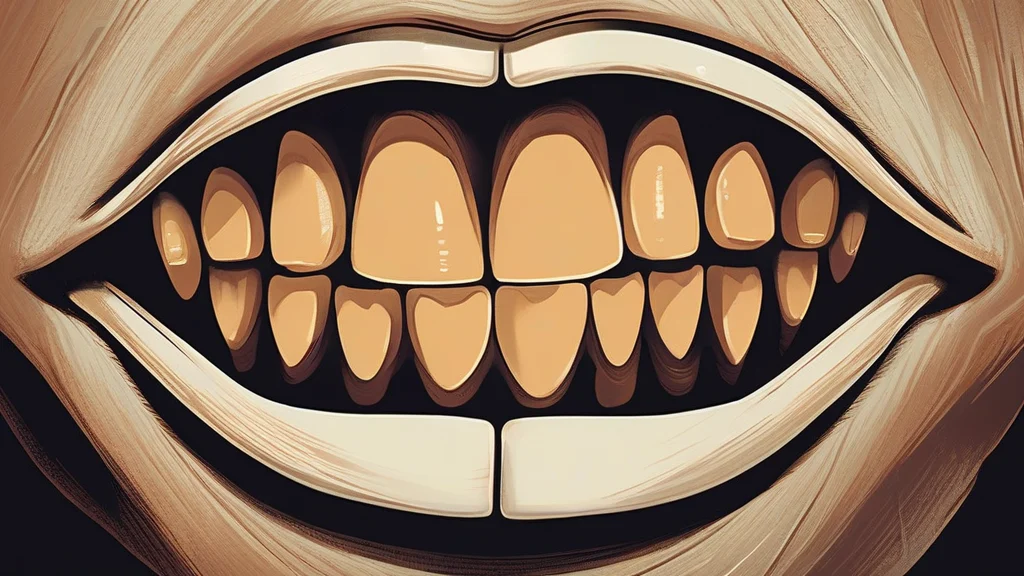
What does buckteeth mean?
Buckteeth are front teeth—most often the upper incisors—that project conspicuously forward beyond the lower teeth. The word is always used in the plural form and belongs chiefly to informal English, where it frequently appears in childhood recollections, descriptions of appearance, and lighthearted teasing. Because the term can carry unflattering connotations, writers aiming for neutral or clinical tone usually prefer precise orthodontic vocabulary instead. The word's origin lies in the adjective 'buck,' long applied to animals and things that jut or spring outward, combined with 'tooth.' Culturally, buckteeth have served as shorthand for awkward adolescence in cartoons and comedy, which has reinforced their comic associations. Understanding the word is useful both for reading older fiction and informal commentary and for recognizing why modern usage increasingly favors kinder, more technical alternatives when discussing dental prominence.
nounProtruding front teeth, especially large or prominent upper incisors that project noticeably forward.
- Prominent, protruding upper front teeth, especially when projecting noticeably beyond the lower teeth.
"As a child he was teased for his buckteeth, though orthodontics eventually corrected them."
"Her buckteeth gave her smile a distinctive, endearing character."
"The orthodontist explained that his buckteeth could be realigned with braces."
Because the word names a paired feature, the plural is the standard form; the singular 'bucktooth' exists but is rarely used.
"Both children inherited their father's buckteeth."
The 'buck' in buckteeth likely echoes the way the teeth jut out like a rearing deer's chest — a comparison old enough that the word has been mocking smiles for centuries.
Reviewed by Deb Chak, Editor. AI-assisted content curated by RJS Tech Solutions LLP.
Etymology of buckteeth
The word combines 'buck,' an adjective describing something that juts, springs, or projects outward—a sense applied to animals and objects alike—with 'tooth,' from Old English 'tōth.' The plural form 'buckteeth' arose naturally because the condition typically affects both central incisors. It developed within English itself rather than being borrowed, so it has no classical cognates, though its components tie into the broader Germanic family of words for teeth and leaping movement.
Related word forms
How buckteeth is actually used
Informal and somewhat colloquial; often carries teasing or mildly pejorative connotations, so care is warranted in polite or clinical contexts. In dental or medical writing, terms such as overjet or protrusive incisors are preferred. Used chiefly in the plural; the singular 'bucktooth' is rarer.
Easily confused with buckteeth
'Buckteeth' refers to prominent human front teeth, while 'buck' in equestrian contexts relates to a horse jumping or kicking, not to teeth.