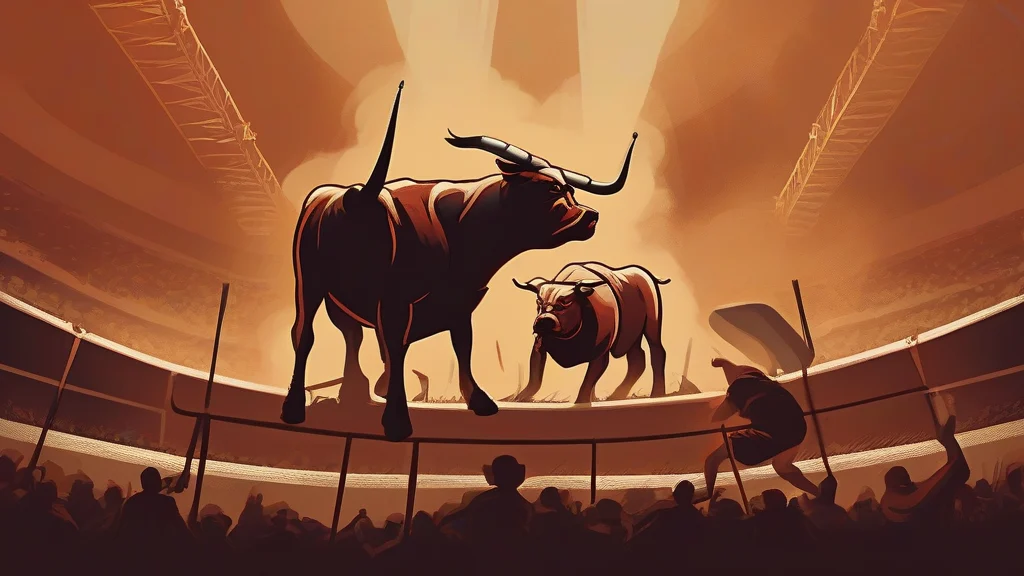
What does bullbaiting mean?
Bullbaiting was a popular spectator sport, particularly in England, in which a bull was chained or staked in an arena and attacked by trained dogs — usually ancestors of the modern bulldog — while crowds watched and bet on the contest. Practiced since at least the medieval period, it persisted for centuries as public entertainment and was even believed by some to tenderize the meat of the bull. The sport inflicted severe injury and death on both animals, and growing concern over animal cruelty led reformers such as those in the RSPCA's early movement to campaign against it. Bullbaiting, along with bearbaiting and cockfighting, was finally outlawed in Britain by the Cruelty to Animals Act of 1835. Today the word survives mainly in historical writing and in accounts of how such spectacles shaped the physical characteristics of breeds like the bulldog.
nounA former blood sport in which a bull was tied to a stake or ring and set upon by dogs, typically bulldogs bred for the purpose, while spectators watched and wagered on the outcome. It was widely practiced in England from medieval times until it was outlawed by the Cruelty to Animals Act of 1835.
- A historical blood sport in which dogs attacked a tethered bull before spectators.
"Bullbaiting was banned in England in 1835, but by then the sport had already shaped the bulldog's distinctive build."
"In Shakespeare's London, a Sunday afternoon at the bullbaiting ring drew crowds from every class of society."
"Animal welfare reformers of the early nineteenth century campaigned tirelessly to end bullbaiting, winning their cause with the 1835 Cruelty to Animals Act."
Rarely pluralized; when referring to multiple events, writers more often use phrases like "bullbaiting contests" or simply "bullbaiting" as an uncountable activity.
"Old parish records mention several bullbaitings held on feast days in the eighteenth century."
The bulldog's famously undershot jaw was bred for one grim job: clamping onto a bull's nose during bullbaiting — and the sport wasn't outlawed in Britain until 1835.
Reviewed by Deb Chak, Editor. AI-assisted content curated by RJS Tech Solutions LLP.
Etymology of bullbaiting
Bullbaiting derives from "bull" (from Old English "bula") combined with "baiting," from the Middle English verb "baiten," meaning to set dogs upon an animal or to worry or harass it. The verb "bait" ultimately traces back through Old Norse "beita" (to cause to bite) to Germanic roots related to biting. The compound noun arose in English to name this specific spectacle, alongside parallel formations like "bearbaiting."
How bullbaiting is actually used
Bullbaiting is an almost exclusively historical term today; it refers to a practice that no longer legally exists and carries strongly negative connotations of cruelty to animals. It is most often encountered in discussions of history, animal welfare legislation, and the breeding history of bulldogs. It may be written with or without a hyphen ("bull-baiting"), though the unhyphenated form is common.
Easily confused with bullbaiting
Bearbaiting is the analogous blood sport involving a bear rather than a bull; the two were often staged at the same venues but involve different animals.