
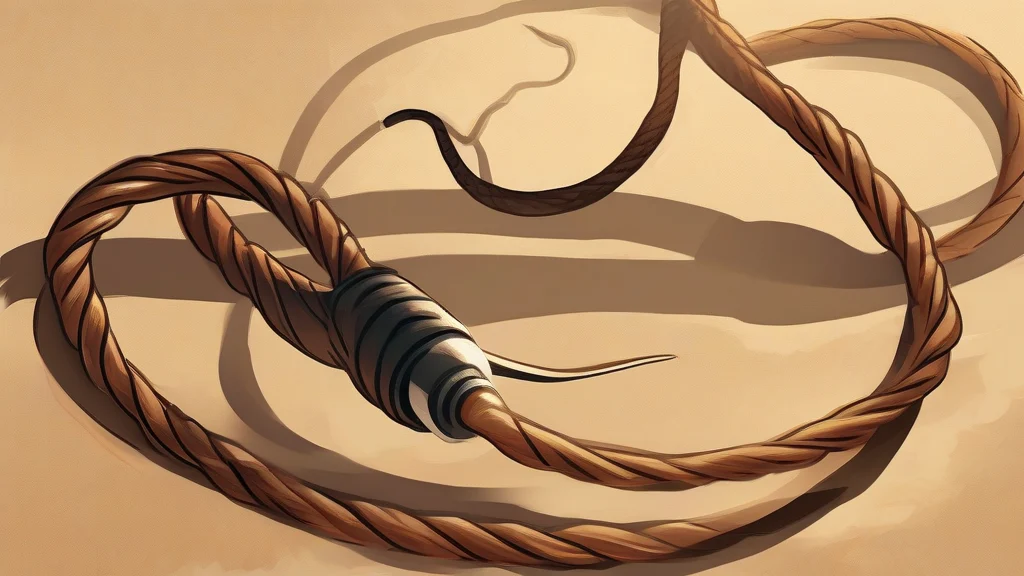
What does bullwhip mean?
A bullwhip is a long, heavy whip, usually plaited from strips of leather into a tapering braid that ends in a fine cord called a cracker. Developed in the nineteenth century for handling cattle, especially on American ranches, it consists of a short rigid handle attached to a long flexible body whose narrowing design allows the tip to accelerate dramatically. When flicked skillfully, the cracker can exceed the speed of sound, producing the sharp crack for which the whip is famous — making the bullwhip the first man-made object known to travel faster than sound. Today the word appears most often in contexts evoking the American West, rodeo events, and circus artistry, where performers use it with theatrical flair. It also survives figuratively, suggesting harsh discipline or relentless pressure, as in working under the bullwhip. In economics, the related term 'the bullwhip effect' describes how small shifts in consumer demand grow increasingly extreme as they move up a supply chain, a metaphor borrowed directly from the snap of the whip. Compact, vivid, and culturally loaded, bullwhip remains a useful word for writers seeking imagery of control, danger, or old frontier life.
A long, heavy leather whip used for driving cattle, capable of producing a loud crack when flicked.
"She cracked the bullwhip overhead and the cattle turned toward the corral."
Often used attributively, as in 'bullwhip crack' or 'bullwhip effect'.
To strike or drive with a bullwhip; figuratively, to coerce or drive relentlessly.
"The overseer was said to bullwhip any mule that balked at the crossing."
Regular plural; used both for physical whips and figurative instances of coercion.
"A rack of polished bullwhips hung behind the saddlery counter."
Cracked correctly, the tip of a bullwhip moves faster than sound — it's the first human invention to break the sound barrier, producing a genuine sonic boom.
Reviewed by Deb Chak, Editor. AI-assisted content curated by RJS Tech Solutions LLP.
Etymology of bullwhip
Bullwhip is a straightforward English compound of 'bull' (a castrated male bovine, later any ox or bull) and 'whip', formed when such long drovers' whips became common in the cattle trade. It emerged in American English during the nineteenth century, coinciding with the expansion of ranching in the western United States. Its components are both ancient Germanic words native to English, so it has no foreign cognates beyond the ordinary Germanic relatives of 'whip' found in languages such as Dutch and German.
How bullwhip is actually used
Primarily associated with the American West, rodeo culture, and circus performance; in modern business writing, 'the bullwhip effect' is a well-established supply-chain term describing how small demand fluctuations amplify upstream. The figurative use ('under the bullwhip') carries strong connotations of coercion and hardship.
Easily confused with bullwhip
A stockwhip is an Australian whip with a very long flexible handle, whereas a bullwhip has a shorter rigid handle and a heavier, longer cracker.
Whiplash is primarily an injury caused by sudden jerking motion of the neck (or a lash itself), not the long braided whip known as a bullwhip.