What does bumblebee mean?
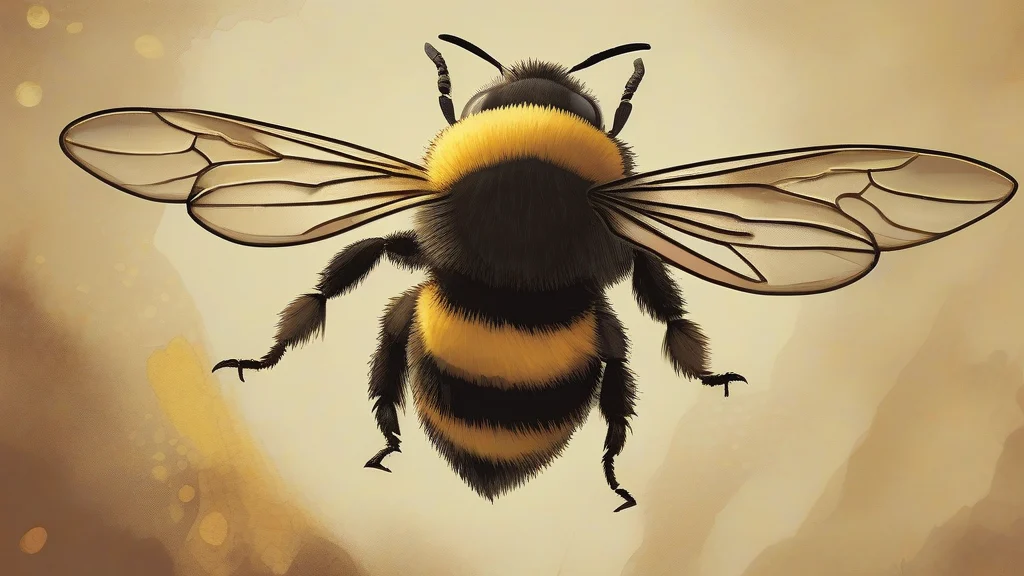
The bumblebee is a large, stout-bodied, densely hairy bee belonging to the genus Bombus, instantly recognizable by its black-and-yellow banded coloring and the deep buzzing hum produced by its rapidly beating wings. Unlike honeybees, bumblebees live in much smaller annual colonies founded by a single overwintered queen, and they store only modest amounts of honey, surviving instead by foraging continuously through the warmer months. They are among nature's most effective pollinators, able to fly in cooler temperatures than many other insects and capable of 'buzz pollination,' a vibration technique essential for crops such as tomatoes. The word itself dates from the early seventeenth century and derives from 'bumble,' an old English term evoking a humming or booming sound; the older synonym 'humblebee' still lingers in dialect. In common speech the bumblebee carries affectionate, harmless associations, appearing frequently in gardens, poetry, and children's stories.
nounA large, hairy, social bee of the genus Bombus, typically marked with black and yellow bands and known for the loud buzzing sound it makes as it flies.
- A large hairy social bee of the genus Bombus with black-and-yellow banding, important as a pollinator.
"A bumblebee droned lazily from one lavender bloom to the next in the summer garden."
"The bumblebee hovered uncertainly at the window before bumping against the glass."
"Commercial growers now rent colonies of bumblebees to pollinate greenhouse tomatoes."
Standard plural; also acceptable as 'bumble bees' in informal writing, though the closed form is preferred.
"Dozens of bumblebees swarmed around the flowering currant bush."
Bumblebees were long said to defy the laws of aerodynamics — a myth that stuck because their plump bodies seem too heavy for those tiny wings, though science has thoroughly debunked it.
Reviewed by Deb Chak, Editor. AI-assisted content curated by RJS Tech Solutions LLP.
Etymology of bumblebee
Bumblebee comes from 'bumble,' an English word imitative of a humming or booming sound, first recorded as part of the compound in the early seventeenth century. It gradually replaced the older term 'humblebee,' which had been used since Middle English and survives in some dialects. The scientific genus name Bombus, from Latin, means the same thing — a buzzing or booming noise.
How bumblebee is actually used
Informal but standard in both British and American English. The older form 'humblebee' survives mainly in dialectal and historical usage. In British English 'bumble-bee' was traditionally hyphenated, though solid spelling is now standard. The word carries warm, gentle connotations in everyday speech and children's literature.
Easily confused with bumblebee
A honeybee is a smaller, less hairy bee (Apis) kept for honey production, whereas a bumblebee is larger, rounder, and hairier, producing only small amounts of honey.
'Bumble' is a verb meaning to move or act clumsily, while 'bumblebee' is the insect noun; the word 'bumble' appears within it but refers to the buzzing sound rather than clumsiness.