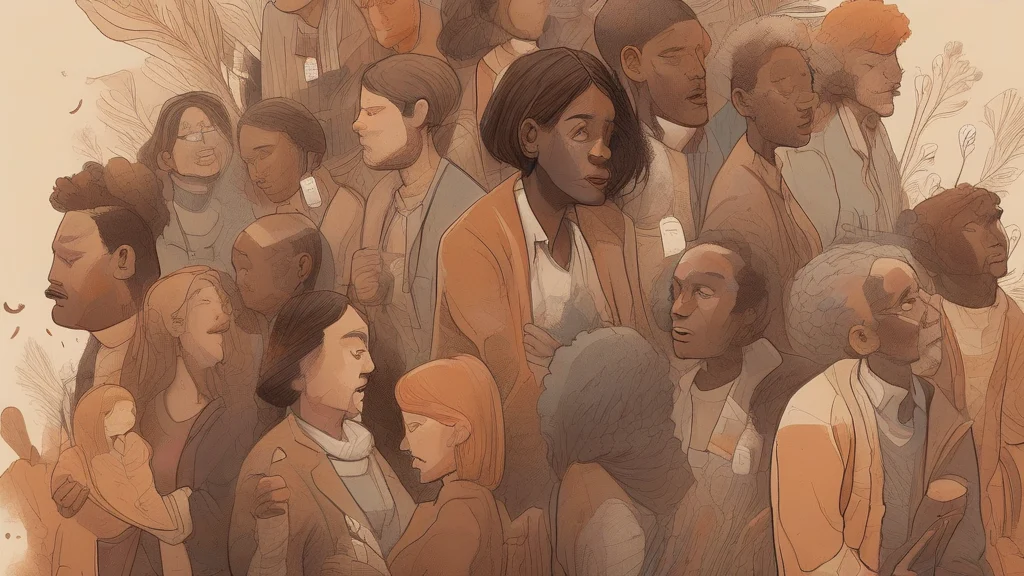
What does bunched mean?
Bunched is the past-tense and past-participle form of the everyday English verb 'bunch,' meaning to gather things or people tightly together into a small cluster or compact mass. It also functions as an adjective describing anything so gathered — bunched fabric, bunched flowers, bunched-up traffic, or bunched fists. The image behind the word is simple and physical: many separate items pressed close until they read as a single unit. That concrete quality gives 'bunched' wide usefulness across registers, from casual speech ('we all bunched around the phone') to technical description ('the fibres were bunched into a cable'). It is neutral in tone, common in both British and American English, and frequently appears in fixed phrases such as 'bunched up' and 'bunched together'. Related forms include the noun 'bunch' (a cluster itself), the adjective 'bunchy', and the gerund 'bunching'. For anyone describing crowding, gathering, or compression — whether of grapes, crowds, or muscles — 'bunched' offers a precise and vivid term.
To have gathered people or things closely together into a cluster or compact group.
"The sheep bunched together when the dog approached."
Standard past-tense form of 'bunch'; fully regular.
Formed into or characterised by a tight cluster or compact mass.
"He wore a coat with bunched sleeves that were slightly too long."
Often used in the phrase 'bunched up'.
When runners 'bunch up' at the start of a race, they're doing exactly what grapes on a vine do — physics and biology agreeing on one handy word.
Reviewed by Deb Chak, Editor. AI-assisted content curated by RJS Tech Solutions LLP.
Etymology of bunched
The word traces back to 'bunch', which appeared in English by the late sixteenth century meaning a protuberance or swelling, and soon after a clustered group of things. The origin of 'bunch' itself is uncertain — it may relate to 'bundle' or to older Germanic words for a lump or swelling — but its development within English is well documented. 'Bunched' emerged naturally as its past-tense and participial form as the verb sense of gathering into a cluster became established.
Related word forms
How bunched is actually used
Commonly used as an adjective describing physical clustering — of people, fabric, muscles, or objects. In sports commentary, 'bunched up' often describes competitors tightly grouped in position or time. The word carries no strong connotation; register is neutral and it appears freely in both formal and informal writing.
Easily confused with bunched
'Bunched' means formed into a tight cluster, while 'brunched' is a rare verb form relating to eating brunch and is not a standard English word.
'Bunch' is the base noun or verb referring to a group or the act of grouping, whereas 'bunched' specifically describes something already formed into such a group.