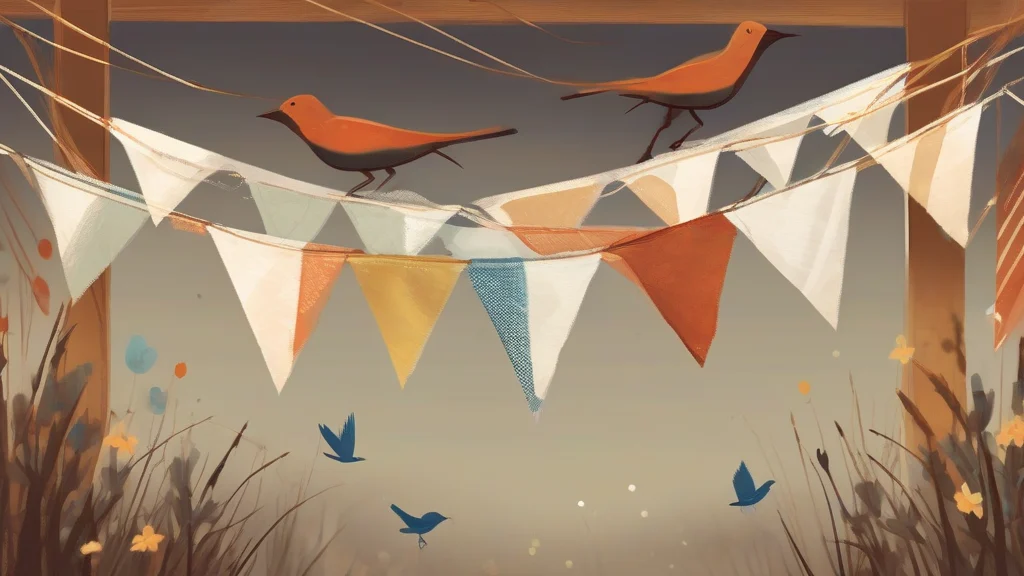
What does bunting mean?
Bunting has two distinct meanings in modern English. Its most familiar sense today refers to the strings of brightly colored triangular or rectangular cloth flags hung across streets, gardens, and halls to lend a festive air to weddings, fetes, festivals, and national holidays — particularly in Britain, where bunting is an emblem of street parties and patriotic celebration. The word also names a group of small, plump, seed-eating songbirds of the Old World family Emberizidae, including species such as the corn bunting, reed bunting, and yellowhammer, many of which are streaked brown and found in open country. The two senses share a curious history: the bird name came first, recorded centuries ago, and its origin remains genuinely obscure, while the decorative sense developed later, apparently by association with the bird's name. In use, decorative bunting behaves as an uncountable noun — one speaks of hanging 'some bunting' rather than counting individual pieces — whereas the bird takes an ordinary plural. The word thus bridges celebration and countryside, carrying cheerful connotations of communal festivity on one hand and quiet natural history on the other.
Brightly colored cloth flags or streamers hung in strings as decoration for festive or patriotic occasions.
"Red-and-white bunting draped every balcony along the parade route."
Usually uncountable when referring to the decoration.
A seed-eating songbird of the Old World family Emberizidae, typically streaked brown and found in open habitats.
"We spotted a reed bunting perched among the rushes."
Only the bird sense takes a regular plural. The decorative-fabric sense is normally used as an uncountable mass noun.
"Corn buntings have declined sharply across farmland in recent decades."
The festive flags we call bunting were named after a plain brown songbird — though nobody is quite sure how the connection happened.
Reviewed by Deb Chak, Editor. AI-assisted content curated by RJS Tech Solutions LLP.
Etymology of bunting
The bird name 'bunting' appears in English very early, by the Middle English period, but its ultimate origin is uncertain and has never been securely traced, so lexicographers generally mark it as of unknown derivation. The decorative sense of 'bunting' arose later, apparently from an association with the bird's name, though the exact reason for that link is likewise unclear; it was well established by the eighteenth century. Because the word's root is obscure, it has no true cognates in other languages.
How bunting is actually used
As decoration, 'bunting' is usually treated as an uncountable mass noun ('some bunting', not 'two buntings'), while as a bird name it takes a normal plural ('buntings'). The decorative sense is common in British English especially, where bunting is strongly associated with street parties, fetes, and royal or national celebrations.
Easily confused with bunting
In baseball, a 'bunt' is a deliberately short hit made by loosely holding the bat, whereas 'bunting' refers either to decorative flags or to birds of the genus Emberiza.