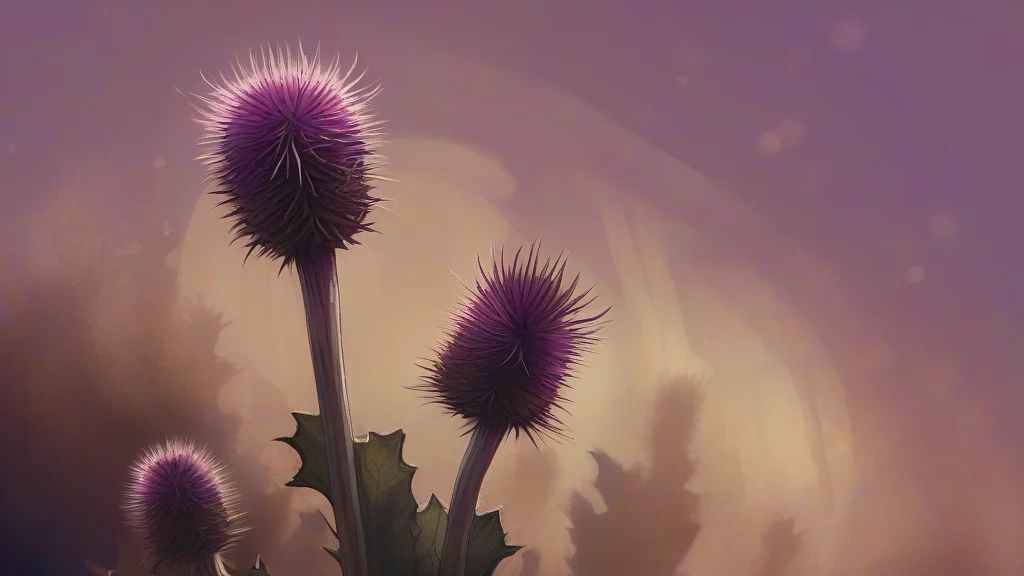
What does burdock mean?
Burdock is a coarse, broad-leaved plant of the genus Arctium, native to Eurasia but naturalized widely across North America. Growing as a biennial, it produces rounded purple flower heads that mature into spherical burrs covered in tiny hooks — structures so effective at gripping fabric and fur that they famously inspired the invention of Velcro. Though often treated as an invasive weed in pastures and along roadsides, burdock has long been valued as food and medicine: its slender taproot, rich in inulin, is eaten in Japanese cuisine under the name gobo, and the root appears in traditional European and Asian remedies. In everyday English the word carries no strong connotation; it simply names the plant, whether one is complaining about burrs in a dog's coat, weeding a garden, or shopping for fresh root vegetables.
nounA coarse Eurasian plant of the genus Arctium in the daisy family, bearing purple flower heads that develop into hooked bristly burrs that cling to animals and clothing.
- The biennial plant Arctium, especially common burdock (Arctium lappa), with large leaves and purple flower heads that form clinging burrs.
"The hedgerow was thick with burdock, its sticky burrs catching at their sleeves as they passed."
"She dug up a young burdock and roasted its long taproot for dinner."
"Walking home through the fields, his wool sweater collected dozens of burdock burrs."
Regular plural; used when referring to individual plants.
"The field edge was crowded with tall burdocks."
The sticky burrs of the burdock inspired Swiss engineer George de Mestral to invent Velcro after examining them under a microscope.
Reviewed by Deb Chak, Editor. AI-assisted content curated by RJS Tech Solutions LLP.
Etymology of burdock
Burdock is a compound formed in Middle English from "bur," meaning a prickly seed head, and "dock," an old name for various broad-leaved plants, both elements traceable to Old English. The word thus literally describes a dock-like plant that bears burs. Its Germanic roots make it part of the native English botanical vocabulary rather than a borrowing from Latin or Greek, so it has few true cognates beyond related Germanic plant names.
How burdock is actually used
In culinary and herbal contexts, "burdock" usually refers specifically to the edible taproot, known in Japanese cuisine as gobo. The word is neutral in register and appears mainly in botany, gardening, foraging, and cooking contexts.
Easily confused with burdock
A bur is the prickly seed head itself (as on any plant), while burdock is the whole plant whose flower heads produce such burs.