What does bureau mean?
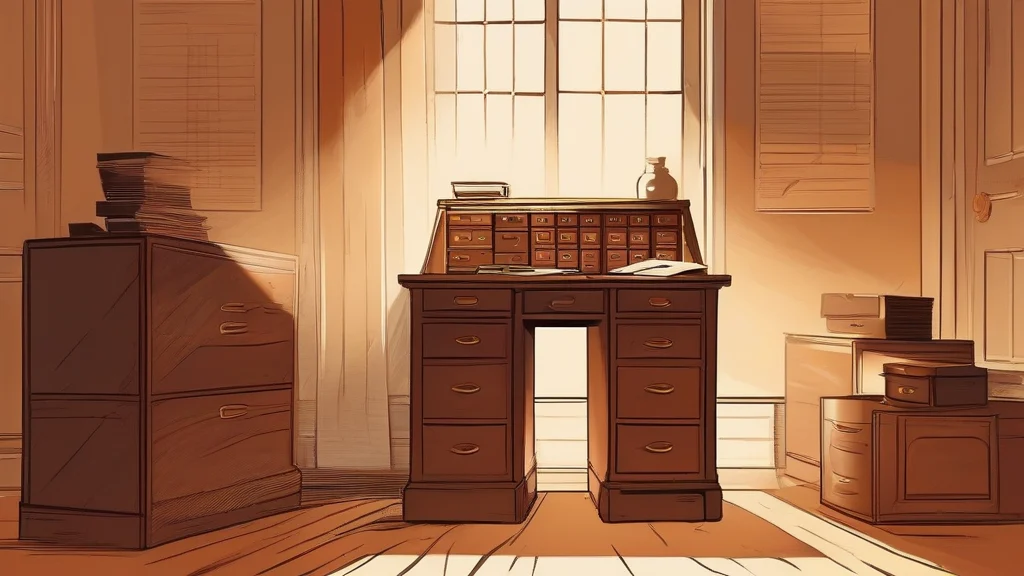
A bureau is most commonly understood as an office, department, or agency organized to provide a specific service — think of a credit bureau, a travel bureau, or the Federal Bureau of Investigation. In this sense the word appears constantly in institutional names and everyday speech about government and business. In British English, however, bureau has an equally familiar second life as a piece of furniture: a chest of drawers, often topped by a writing surface or mirror, or more narrowly a slant-fronted writing desk of the kind fashionable in the eighteenth and nineteenth centuries. The word came into English from French, where it originally denoted the coarse cloth covering a counting-room table, then the desk itself, and finally the room where official work was done. Its derivatives include bureaucracy, bureaucrat, and bureaucratic — terms that carry connotations of red tape and official procedure.
An office, department, or agency that provides a particular service, collects information, or handles administrative business.
"He filed a report with the local news bureau."
This is the dominant sense in American English and in international usage.
A chest of drawers, typically with a writing surface or mirror, or a writing desk fitted with drawers.
"She kept her letters locked in the top drawer of the bureau."
This sense predominates in British English.
American English standardizes on 'bureaus', while British English frequently preserves the French-style plural 'bureaux'. Both are accepted.
"Several regional bureaux contributed stories to the feature."
The word 'bureau' literally began as a coarse woolen cloth draped over a writing table — which is why so many government agencies are named after a piece of furniture.
Reviewed by Deb Chak, Editor. AI-assisted content curated by RJS Tech Solutions LLP.
Etymology of bureau
Bureau entered English from French in the late seventeenth century. The French word traces back through Old French 'burel' or 'bure', a coarse brownish woolen cloth, which was used to cover writing tables in offices; the word shifted to mean the desk itself, then the office containing it, and finally the institution. This chain gives modern English both its institutional sense (an office or agency) and its furniture sense, along with the later coinage 'bureaucracy', formed in French from bureau plus the Greek-derived suffix '-cratie'.
Related word forms
How bureau is actually used
In American English, the plural is typically 'bureaus'; in British English it is often the French-style 'bureaux'. The furniture sense dominates in Britain, while the institutional sense dominates worldwide, particularly in names of agencies such as the FBI or local credit bureaus. The word can carry slightly bureaucratic connotations when applied to institutions.
Easily confused with bureau
A bureau de change is specifically a business that exchanges one currency for another, whereas 'bureau' alone refers broadly to any office, agency, or piece of furniture.