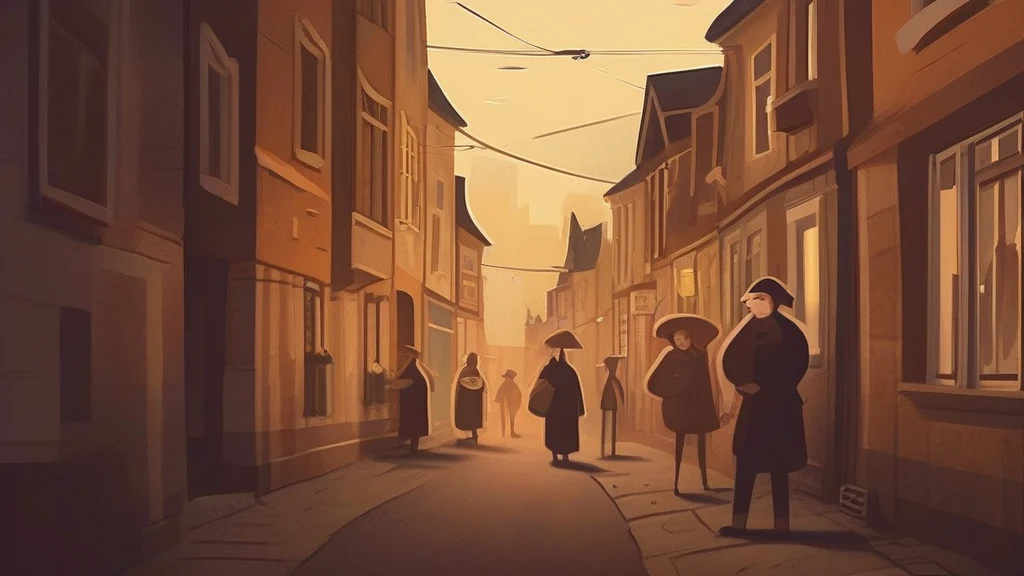
What does burgher mean?
A burgher is historically a freeman or citizen of a European town — particularly a member of the propertied middle class that dominated the civic life of German, Dutch, Flemish, and other trading cities from the Middle Ages onward. Burghers held municipal rights such as voting, trading privileges, and participation in guilds, which set them apart from both the rural peasantry and the landed aristocracy. The word is most often met today in historical, artistic, or literary contexts: Rembrandt's patrons were Dutch burghers, and writers use the term to evoke solid, respectable urban prosperity — sometimes with a hint of complacent materialism. It derives from the same root as 'borough' and 'bourgeois', all tracing back to a Germanic word for a fortified place. Though formal in register, it remains a precise and evocative term for the urban middle classes of pre-modern Europe. In Sri Lanka it also names an ethnic community descended from European colonists.
nounA burgher is an inhabitant of a town or city, especially a member of the wealthy, property-owning middle class in a European town; historically, a full citizen with municipal rights in a German or Dutch town.
- A freeman or citizen of a town, especially one of the property-holding middle class in German, Dutch, or other European cities.
- More broadly, any inhabitant of a town or city.
"The prosperous burghers of Amsterdam commissioned portraits from Rembrandt to display their standing."
"In medieval Bruges, only burghers were entitled to vote in civic affairs."
"The painting depicts a well-to-do burgher and his wife amid their household possessions."
Standard plural; used for multiple townspeople or members of the class collectively.
"The burghers of the Hanseatic cities grew rich on Baltic trade."
'Burgher' and 'burger' sound almost identical, yet one means a medieval town's respectable middle class and the other means lunch — a mix-up that has delighted editors for generations.
Reviewed by Deb Chak, Editor. AI-assisted content curated by RJS Tech Solutions LLP.
Etymology of burgher
'Burgher' comes from the Dutch 'burger' or German 'Bürger', meaning a citizen of a town (a Burg, or fortified settlement), and entered English around the late 16th to early 17th century as trade with the Low Countries flourished. The root is the Proto-Germanic *burg-, meaning a fortified hill or stronghold, which also gives English 'borough', 'burgh', and 'burgess'. The same Germanic root was borrowed into French to produce 'bourgeois', making 'burgher' and 'bourgeois' doublets of one another.
How burgher is actually used
The word carries a historical, somewhat formal flavour and is most often encountered in discussions of European social history, art history, or literature. In some contexts it can carry connotations of stolid respectability or materialism. A distinct sense survives in Sri Lanka, where 'Burgher' denotes an ethnic community descended partly from Dutch and Portuguese settlers.
Easily confused with burgher
A 'burger' is a sandwich of cooked meat in a bread roll, while a 'burgher' is a citizen of a town — they are pronounced nearly identically but entirely unrelated.