
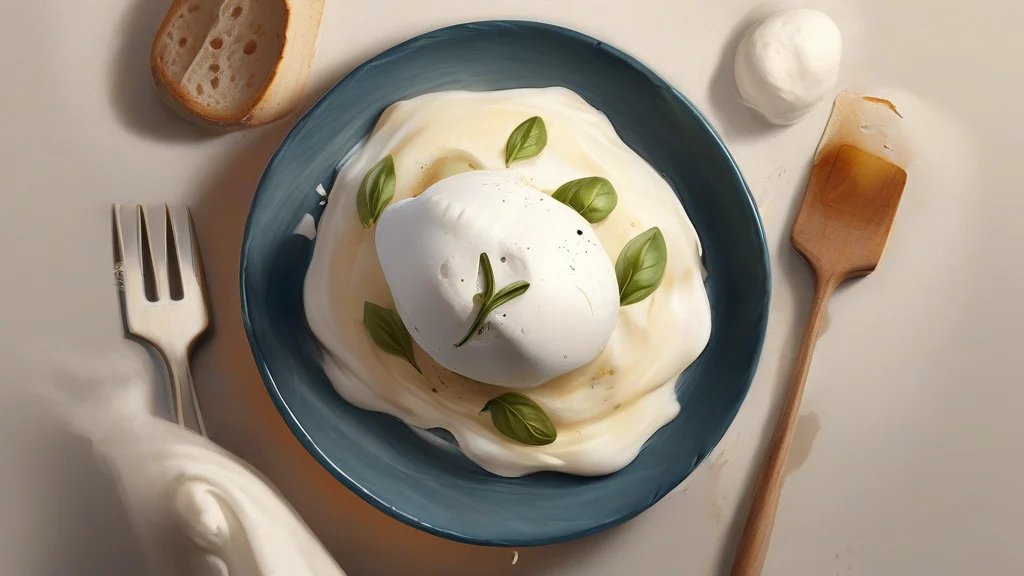
What does burrata mean?
Burrata is a fresh Italian cow's-milk cheese prized for its striking contrast of textures. Formed as a pouch or ball with a thin outer shell of stretched mozzarella curd, it encloses a rich interior of stracciatella — shreds of mozzarella mixed with cream — which spills out luxuriously when the cheese is cut open. Originating in the Apulia region of southern Italy in the early twentieth century, burrata was devised as a way to use up leftover curds, and its name derives from the Italian word for butter, reflecting its creamy character. Today it appears widely on restaurant menus and in home kitchens, typically served at room temperature alongside tomatoes, prosciutto, or crusty bread and dressed simply with olive oil. Because it is highly perishable, authentic burrata is best eaten within days of being made, making it a marker of freshness and quality on any menu.
nounA fresh Italian cow's-milk cheese consisting of an outer shell of mozzarella enclosing a soft, creamy centre of shredded curd mixed with cream.
- A fresh Italian cheese made by wrapping a thin shell of mozzarella around a filling of stracciatella (shredded mozzarella curd) and cream.
"The salad came topped with a whole burrata, its creamy centre spilling out at the first cut."
"She served the burrata with ripe heirloom tomatoes, basil, and a drizzle of olive oil."
"Once the burrata is cut open, the rich, creamy centre flows over the rest of the dish."
The plural burrate comes from Italian grammar; however, in everyday English usage burrata is usually treated as singular or uncountable, so 'two burratas' is common informally while 'burrate' remains rare outside Italian contexts.
"The cheese counter had two burrate left from the morning delivery."
Burrata literally means 'buttered' in Italian — and cutting into it releases a molten heart of cream and shredded curd that earned it the nickname 'the gift-wrapped cheese.'
Reviewed by Deb Chak, Editor. AI-assisted content curated by RJS Tech Solutions LLP.
Where does burrata come from?
Burrata takes its name directly from Italian, where burrata means 'buttered', derived from burro ('butter'). Burro itself traces back through Italian to Latin butyrum ('butter'), a word ultimately borrowed from Greek boutyron, meaning 'cow cheese'. This makes burrata a relative of English words such as butter and butyric. The cheese itself was created in Apulia, in southern Italy, in the early twentieth century, reportedly at the Andria dairy farm of Lorenzo Bianchino Chieppa.
How burrata is actually used
A culinary term used in food writing and restaurant menus; always refers to the fresh cheese and should be eaten soon after production, as it does not keep well. The plural form 'burrate' exists in Italian usage but 'burrata' is often treated as uncountable or singular in English contexts.
Easily confused with burrata
Mozzarella is uniformly solid throughout, whereas burrata has a mozzarella-like outer shell filled with a soft, creamy interior of stracciatella and cream.