What does buskin mean?
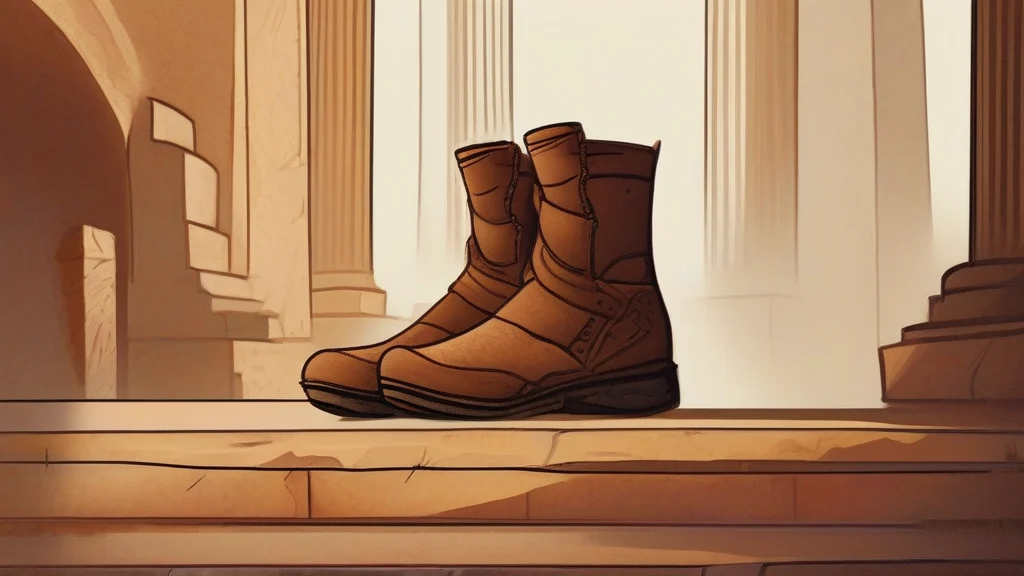
A buskin is a high boot or half-boot, typically laced up the leg, that has played two distinct roles in history. In everyday dress, it was a sturdy leather boot worn for riding, hunting, or travel from the medieval period onward. More famously, in ancient Greek and Roman theatre, the buskin was the thick-soled, height-adding shoe associated with tragic actors, giving them a commanding physical presence on stage. This theatrical association survives in figurative language: writers and critics still speak of 'the buskin' as a symbol of tragedy and lofty drama, set against 'the sock,' which stands for comedy. Today the word appears chiefly in historical writing, costume studies, and literary criticism rather than casual conversation, lending any sentence it appears in an antique, scholarly flavor. For readers interested in theatre history or the vocabulary of dress, 'buskin' offers a compact link between everyday footwear and the grand tradition of classical drama.
nounA thick-soled, high-lacing boot or half-boot; in ancient Greek and Roman theatre, the elevated footwear traditionally associated with tragic actors.
- A high, laced boot or half-boot reaching the knee, historically worn for protection or fashion.
- The elevated footwear (cothurnus) of classical tragic actors, hence a symbol of tragedy or dramatic grandeur.
"The actor towered over the stage in his towering buskins, lending the tragic hero an imposing stature."
"She laced her knee-high buskins before setting out across the muddy moor."
"In his lecture on Greek drama, he used 'the buskin' to stand for tragedy itself, as opposed to 'the sock' of comedy."
Because boots come in pairs, the plural 'buskins' is the natural form when describing the garment itself; the singular 'buskin' tends to survive mainly in the figurative theatrical sense.
"He pulled on his buskins and strode out into the rain."
In ancient theatre, actors wore buskins so tall that your footwear literally announced your genre — tragedy wore the boot, comedy wore the sock.
Reviewed by Deb Chak, Editor. AI-assisted content curated by RJS Tech Solutions LLP.
Etymology of buskin
The origin of 'buskin' is genuinely obscure, which lexicographers have long acknowledged. The word appeared in English by the early 16th century, likely borrowed from Old French, but the ultimate source remains uncertain. What is well established is the word's strong association with classical theatre: Renaissance scholars applied it to the cothurnus, the elevated boot of Greek and Roman tragedians, cementing its symbolic role as the emblem of tragedy. No reliable cognates in other languages can be stated with confidence, reflecting the word's murky etymology.
How buskin is actually used
Mostly literary and historical in modern usage. In drama criticism, 'the buskin' is often used figuratively to denote tragedy or elevated, serious drama, by contrast with 'the sock,' which denotes comedy — both terms derive from the traditional footwear of Greek and Roman stage performers.
Easily confused with buskin
Buckskin refers to soft leather made from deer hide (or its yellowish color), while a buskin is a lace-up boot or theatrical footwear.