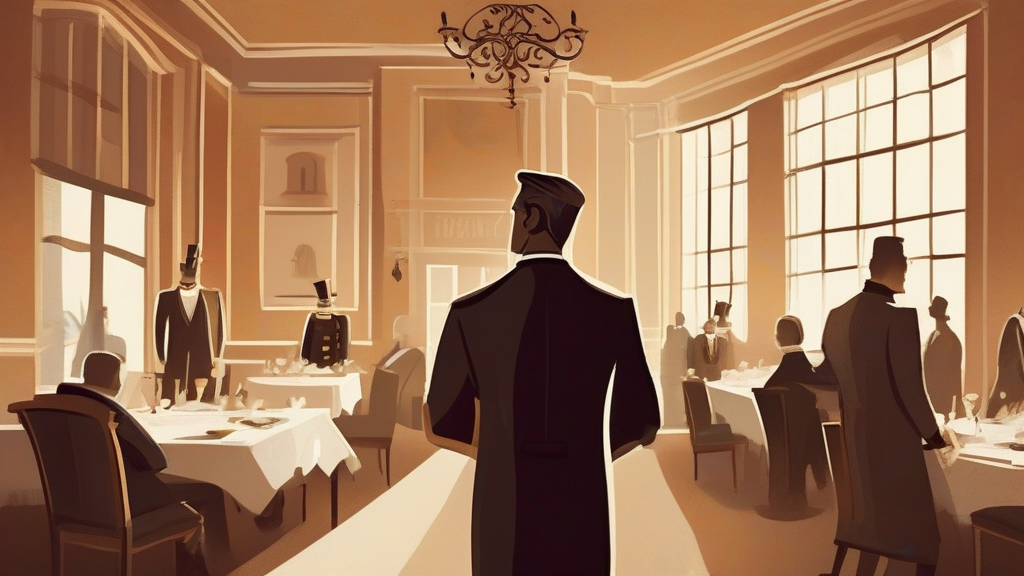
What does butler mean?
A butler is the senior servant in a large household, historically charged with managing the dining room, supervising the domestic staff, and — above all — safeguarding the wine cellar, whose contents were among the most valuable assets of an aristocratic home. The word comes through Old French from the Latin for cask or bottle, reflecting this original association with drink storage. Today the title survives most vividly in Britain and in luxury hospitality, where "butler service" signals personalized, high-touch care in fine hotels. Culturally, the butler is a stock figure of discretion and quiet competence, immortalized by characters such as P.G. Wodehouse's Reginald Jeeves and cemented in popular imagination by the detective-fiction cliché that "the butler did it." Whether describing a real profession or evoking a vanished world of formal grandeur, the word carries connotations of elegance, loyalty, and impeccable service.
The principal male servant of a large household, in charge of table service, the wine cellar, and the supervision of other domestic staff.
"The butler polished the silver before the countess's dinner party."
Historically specific to grand British households; now also common in hotel and luxury-service contexts.
(Informal) To work as a butler; to perform a butler's duties.
"After retiring from the navy, he took up butlering at a country estate."
Rare and humorous in tone; popularized by P.G. Wodehouse's writings.
Regular plural; the verb sense takes standard third-person forms such as "butlers" or "butlered".
"The agency placed several experienced butlers with wealthy families across London."
The cliché "the butler did it" was born in detective fiction — yet in real great houses, the butler outranked every other servant because he guarded the one thing money prized most: the wine cellar.
Reviewed by Deb Chak, Editor. AI-assisted content curated by RJS Tech Solutions LLP.
Etymology of butler
Butler derives from Old French "bouteillier", meaning a keeper of bottles or officer in charge of the wine, itself formed from "bouteille" (bottle). The Old French word traces back through Medieval Latin "buticularius" to Late Latin "butticula", a diminutive of "buttis" meaning cask. English adopted the word in the Middle Ages, and its original sense of custodian of the wine cellar gradually broadened to describe the head of the household staff generally. It thus shares its deep origin with "bottle" and with the wine-measure "butt".
How butler is actually used
Traditionally a British institution associated with grand households, the term is now used worldwide in hospitality contexts such as hotels and private clubs. The verb form is rare, informal, and often jocular. In period drama and detective fiction, the butler carries strong connotations of discretion, formality, and old-fashioned service.
Easily confused with butler
"Bottle" is a container for liquids and shares butler's ultimate Latin origin via Old French "bouteille", but it is a completely unrelated word in meaning.