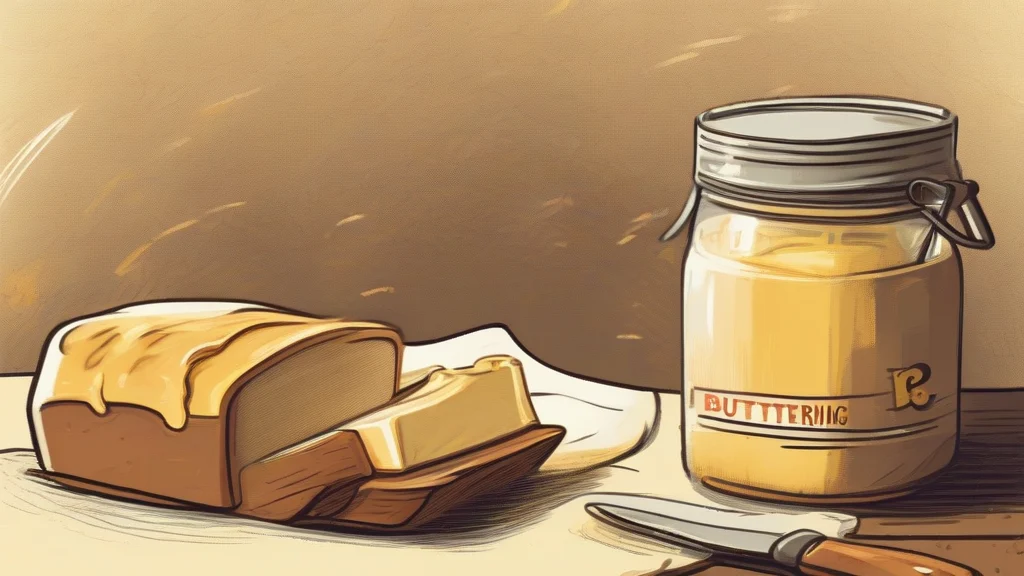
What does buttering mean?
Buttering is the gerund of the verb 'to butter', denoting the act of spreading or applying butter to something, most commonly bread, toast, or a cooking pan. In everyday kitchen use, it is a neutral, almost homely term: buttering warm toast, buttering a sandwich, or buttering a baking dish to keep food from sticking. The word also has an established figurative sense in the idiom 'to butter someone up', which means to flatter a person excessively or insincerely, usually in order to gain favour or advantage; this usage carries a negative, somewhat cynical connotation and appears frequently in workplace and social commentary. Derived ultimately from the Old English word for butter, 'butter' has long been central to English-speaking food culture, and its verbal forms reflect that intimacy. Whether describing a literal kitchen task or a metaphorical act of persuasion, buttering remains a vivid, widely understood term that connects the mundane pleasures of the table with the subtler arts of human influence.
The act of spreading butter on food, or of coating a surface with butter in cooking.
"A thick buttering of the hot crumpets made them irresistible."
Most common in domestic and culinary contexts.
Present participle of the verb 'butter': to spread or coat something with butter.
"She stood at the counter, buttering slice after slice of bread for the sandwiches."
Rarely used; the plural is generally avoided, with the uncountable singular 'buttering' preferred except when referring to multiple distinct instances.
"The recipe calls for several generous butterings of the pastry between folds."
In English idiom, 'buttering someone up' means flattering them insincerely — a phrase so old that ancient Egyptians may have practised it with actual offerings of butter.
Reviewed by Deb Chak, Editor. AI-assisted content curated by RJS Tech Solutions LLP.
Etymology of buttering
The verb 'butter' derives from the noun 'butter', which comes from Old English 'butere', itself borrowed from Latin 'butyrum', taken from Greek 'bouturon'. The Greek compound likely combines 'bou-' (ox, cow) with a word related to cheese, reflecting butter's origin as a dairy product. The gerund 'buttering' follows the standard English pattern of forming verbal nouns from verbs, and the figurative sense of flattery ('buttering someone up') developed as an extension of the idea of smoothing or softening someone with sweetness.
Related word forms
How buttering is actually used
As a gerund noun, 'buttering' is most common in everyday domestic contexts. The idiomatic sense 'buttering someone up' carries a distinctly negative connotation of insincerity or manipulation, and is informal but widely understood in both British and American English.
Easily confused with buttering
'Fluttering' refers to rapid, light movement (as of wings or a heart), whereas 'buttering' refers to spreading butter; they share a similar sound but nothing else.
'Stuttering' is a speech disorder involving interrupted fluency, while 'buttering' is the act of applying butter to food — the words merely rhyme and are unrelated in meaning.