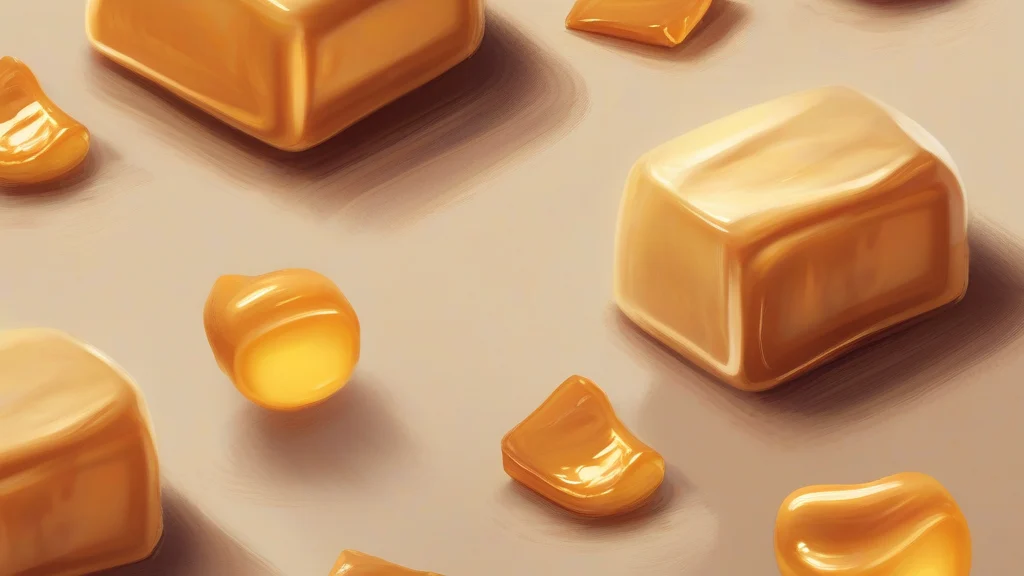
What does butterscotch mean?
Butterscotch is a traditional English confection made by boiling brown sugar together with butter, often with a little water, lemon juice, or cream, until the mixture reaches a hard, brittle consistency. The name refers both to the sweet itself and to its characteristic rich, buttery flavour, which has become popular far beyond the original candy in desserts such as butterscotch pudding, sauce, ice cream, and baked goods. The word dates back at least to the early nineteenth century in Britain, though the exact origin of the 'scotch' element remains debated, with theories ranging from cutting the candy into pieces ('scotching' it) to a connection with Scotland. Butterscotch is closely related to caramel and toffee, differing mainly in its ingredients: brown sugar and butter rather than white sugar alone. In everyday speech the term evokes warmth, nostalgia, and old-fashioned sweetness, making it a beloved descriptor for flavours and colours alike.
nounA hard candy made by boiling brown sugar and butter together, sometimes with lemon juice or cream; also the sweet, buttery flavour associated with this confection.
- A hard brittle confection made from brown sugar boiled with butter.
- The distinctive sweet, buttery flavour or colour of that confection, used in puddings, sauces, ice cream, and other foods.
"She stirred a handful of butterscotch chips into the cookie dough."
"Grandma kept a tin of homemade butterscotch on the sideboard every Christmas."
"The ice cream parlour's most popular sundae came drenched in warm butterscotch sauce."
Used only when counting individual pieces of the confection; the mass-noun sense has no plural.
"There were only three butterscotches left in the jar."
No one knows for sure why it's called 'scotch' — one popular theory says Victorian cooks 'scotched' (scored and snapped) the cooling candy into pieces.
Reviewed by Deb Chak, Editor. AI-assisted content curated by RJS Tech Solutions LLP.
Etymology of butterscotch
Butterscotch is first attested in early nineteenth-century England, notably associated with the town of Doncaster, where confectioners sold it widely. It is a compound of 'butter' (from Old English 'butere', ultimately of Latin origin via Greek) and 'scotch', whose precise sense here is uncertain — leading theories hold that it derives from 'scotch' meaning 'to cut or score' (referring to scoring the cooling candy so it could be snapped into pieces), or from an association with Scotland. Related forms include other compounds built on 'butter', such as buttermilk and buttercup.
Related word forms
How butterscotch is actually used
Primarily used as an uncountable mass noun when referring to the substance or flavour ('a taste of butterscotch') and countably when referring to individual pieces ('two butterscotches'). The word carries warm, nostalgic, old-fashioned connotations in British and American usage alike.
Easily confused with butterscotch
Caramel is made from white granulated sugar cooked to a golden brown, whereas butterscotch uses brown sugar and butter, giving it a deeper, more buttery flavour.
Toffee is essentially a harder, longer-cooked version of the same sugar-and-butter base, often with nuts, while butterscotch is typically softer and flavoured with lemon or cream.