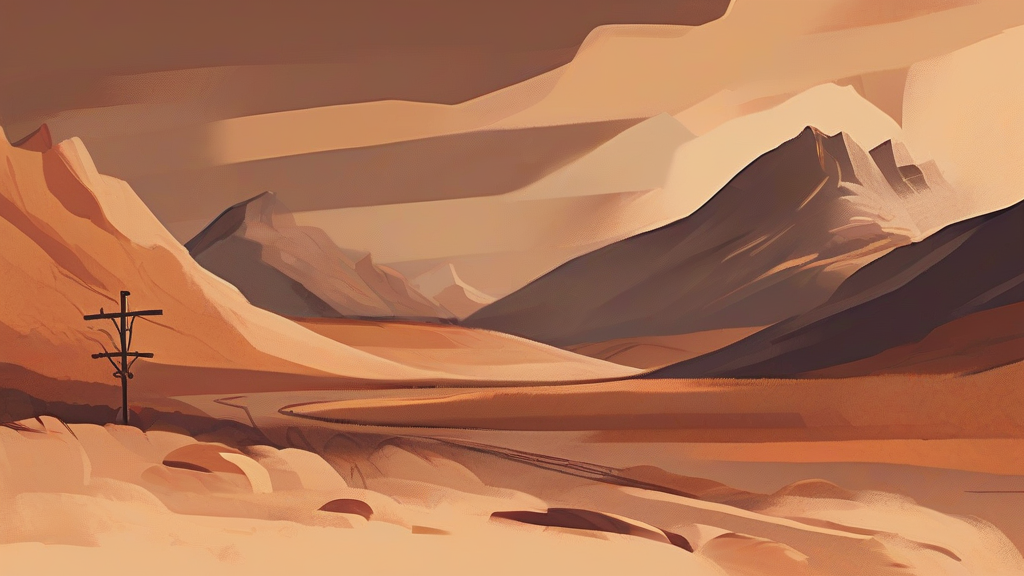
What does butte mean?
A butte is an isolated, steep-sided hill with a flat top, typically rising abruptly from a plain in arid regions such as the American Southwest. Geologically, buttes are erosional remnants — what remains after wind and water wear away softer surrounding material, often leaving behind resistant caprock that shelters the spire beneath. The term belongs to the same family of landform vocabulary as 'mesa' and 'plateau', distinguished mainly by size: a butte's summit is narrower than its height, making these formations slender, dramatic towers of stone. Landmarks such as those in Monument Valley have made the butte an iconic image of the American West, appearing frequently in art, photography, and film. Borrowed from French by early trappers and explorers, the word survives both in scientific description and in numerous place names across western North America.
nounAn isolated hill with steep sides and a small flat top, characteristic of arid regions of western North America.
- An isolated hill with steep sides and a flat top, found especially in arid regions of the western United States.
"The highway curved past a towering red sandstone butte that glowed in the evening light."
"We hiked to the base of the butte just as the morning sun set its red rock ablaze."
"Monument Valley's towering buttes have become one of the most recognizable landscapes in the American Southwest."
The plural 'buttes' is standard and commonly used when describing groups of such formations, as in Monument Valley.
"The valley's towering buttes are among the most photographed landforms in the United States."
The word 'butte' was carried into American English by French fur trappers, which is why the map of the American West is dotted with French names for rocky landmarks — including the entire city of Butte, Montana.
Reviewed by Deb Chak, Editor. AI-assisted content curated by RJS Tech Solutions LLP.
Etymology of butte
The word 'butte' comes directly from the French 'butte', meaning a small hill or mound, and was introduced into American English during the early nineteenth century by French-speaking fur traders and explorers working in the Mississippi Valley and the Far West. The French term itself descends from Old French, though its deeper prehistory beyond medieval French is not firmly established. Its adoption reflects how much of the early mapping of western North America was done by French voyageurs, whose terminology became fixed in the region's place names and geographical vocabulary.
How butte is actually used
'Butte' is used chiefly as a geographical term in North America, particularly in descriptions of the arid West; in British usage it appears mainly in reference to North American landscapes. It is also found in place names, such as Butte, Montana, where it is capitalized.
Easily confused with butte
A mesa is a similar flat-topped landform but is broader at the top than it is tall, whereas a butte is narrower, its top width being smaller than its height.
A plateau is an extensive elevated area of relatively flat land covering a wide region, while a butte is a single, small isolated formation.