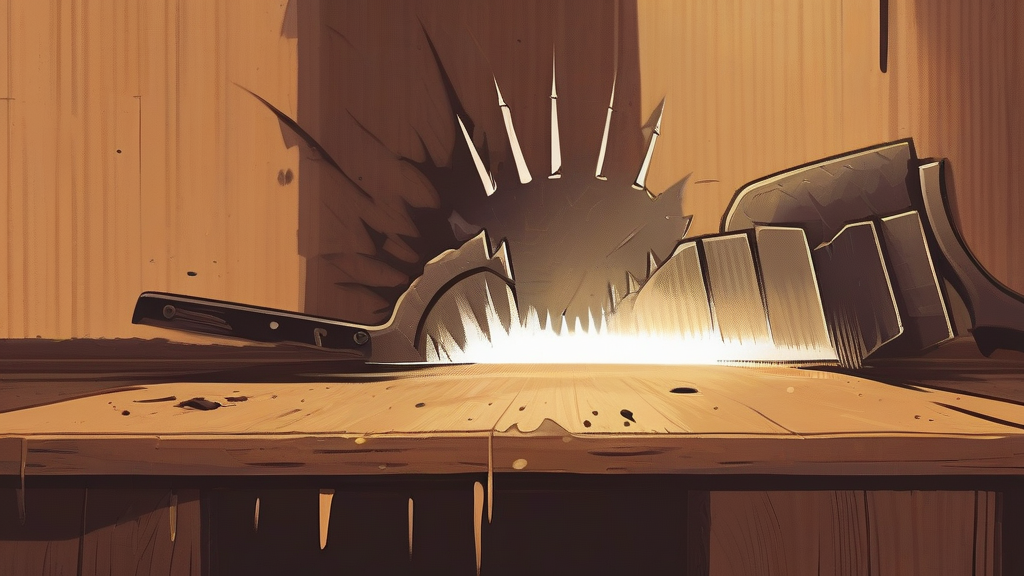
What does buzzsaw mean?
A buzzsaw is a power-driven circular saw whose rapidly spinning, toothed blade emits a distinctive buzzing whine as it slices through wood, metal, or other material — a staple of workshops, mills, and construction sites since industrialization mechanized cutting work. The term is built from "buzz," imitative of the blade's sound, joined to "saw," making it one of those words whose very form describes its function. Beyond the literal tool, buzzsaw has developed a vivid figurative life, especially in American usage: journalists and commentators use it to describe any force that overwhelms its opposition — a dominant sports team, a political campaign that steamrolls rivals, or public opinion that destroys a reputation. In this figurative sense, phrases such as "running into a buzzsaw" convey sudden, merciless destruction. Whether naming a piece of machinery or an implacable adversary, the word consistently evokes speed, noise, and relentless power.
A power-driven circular saw with a toothed blade that produces a loud buzzing sound when cutting.
"He guided the board carefully through the buzzsaw."
Often used interchangeably with "circular saw," though "buzzsaw" more strongly evokes the noise of large stationary mill blades.
Figuratively, an overwhelmingly powerful and destructive person, group, or force that crushes opposition.
"The champion proved to be a buzzsaw, dispatching every challenger in straight sets."
Chiefly North American; common in sports and political journalism, typically in the phrase "run into a buzzsaw."
The plural follows standard English formation. It applies mainly to the literal sense; the figurative sense is rarely pluralized.
"The mill floor was lined with half a dozen roaring buzzsaws."
"Running into a buzzsaw" has nothing to do with lumber — in politics and sport it means hitting an unstoppable force that shreds your plans like a spinning blade.
Reviewed by Deb Chak, Editor. AI-assisted content curated by RJS Tech Solutions LLP.
Etymology of buzzsaw
Buzzsaw is an English compound formed from "buzz," an onomatopoeic word imitating the humming or whirring sound of a spinning blade, and "saw," from Old English "sagu," a cutting tool. The compound arose in the nineteenth century, when mechanically driven circular saws powered by water, steam, or later electricity became widespread in timber mills and workshops. Its figurative extension to describe overwhelming forces followed naturally in American English during the twentieth century, particularly in sports and political reporting.
How buzzsaw is actually used
The literal sense is common in trades and everyday speech, though "circular saw" is often preferred for the specific modern handheld tool. The figurative sense — describing an unstoppable opponent or punishing situation — is chiefly North American and appears frequently in sports journalism and political commentary, usually in phrases like "running into a buzzsaw." The word carries a connotation of noise, violence, and relentlessness in both senses.
Easily confused with buzzsaw
A jigsaw is a reciprocating power tool (or a puzzle) used for cutting curves, while a buzzsaw is a spinning circular blade that cuts with a loud buzzing sound.
A seesaw is a playground plank that tilts up and down on a fulcrum, whereas a buzzsaw is a cutting tool; the two share only the '-saw' ending and rhyming sound.