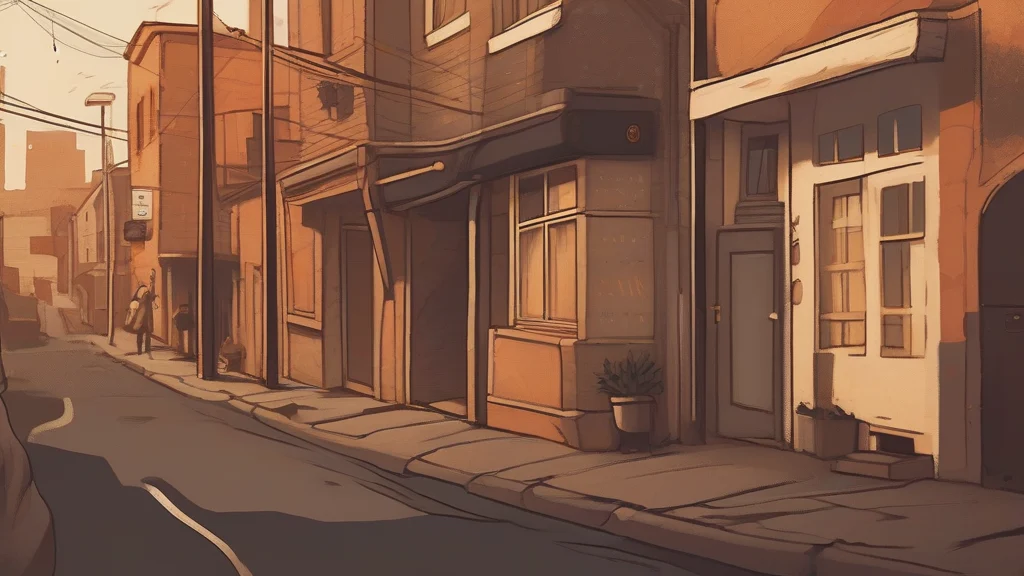
What does bystreet mean?
A bystreet is a small, quiet street that branches off a main thoroughfare, typically carrying little traffic and hosting modest shops, homes, or workshops rather than major commerce. The word belongs to a family of English compounds built on the prefix 'by-', meaning beside or secondary, alongside terms like 'byway' and 'bylaw'. In literal use it describes urban geography: a narrow lane behind a church, a residential side street off a high road. Figuratively, writers use 'the bystreets of' something — history, literature, memory — to evoke its obscure or overlooked corners. The noun has a distinctly literary flavor; it surfaces more often in novels and travel writing than in casual conversation, lending scenes an air of seclusion or gentle shabbiness. For readers and writers alike, it is useful precisely because it condenses atmosphere into a single word: wherever a bystreet appears, the main road's noise is never far away, but neither is it welcome.
nounA bystreet is a quiet secondary or side street, especially one running off a main road and away from its traffic and bustle.
- A quiet secondary street branching off a main road, away from heavy traffic.
- (Figurative) An obscure or unfashionable area of activity or interest, as in 'the bystreets of history'.
"The little bookshop had survived for decades in a shaded bystreet off the high road."
"They found a charming café tucked away in a bystreet behind the cathedral."
"Historians who study everyday life often prefer the bystreets of the past to its grand avenues."
The plural is regular; it is most common in figurative expressions such as 'the bystreets of history' or in descriptions of a town's network of minor streets.
"The walking tour wound through the bystreets of the old quarter, far from the crowded promenade."
'Bystreet' is one of those rare compound nouns that turns an ordinary map feature into an atmosphere — writers reach for it when they want to signal somewhere hidden, old, or just out of earshot of the main road.
Reviewed by Deb Chak, Editor. AI-assisted content curated by RJS Tech Solutions LLP.
Etymology of bystreet
The word combines 'by-', an Old Norse-derived prefix meaning 'beside' or 'secondary' (as seen in bylaw, byway, and byname), with 'street', from Latin 'via strata', a paved way that entered English via Old French and Old English. Bystreet emerged in English as a straightforward compound describing a subsidiary street, with literary use attested by at least the eighteenth century. Its cognates are chiefly other 'by-' compounds such as bypath, byway, and byproduct.
How bystreet is actually used
Bystreet is somewhat literary and old-fashioned in register; it appears more often in descriptive prose than in everyday speech. It carries connotations of seclusion, modesty, or neglect depending on context. It is more commonly encountered in British writing than American.
Easily confused with bystreet
A bystander is a person who observes an event without taking part, whereas a bystreet is a minor street; they share only the 'by-' prefix meaning 'beside' or 'secondary'.
A byway is any minor route, often rural or scenic, while a bystreet specifically refers to a small urban or village street.